

UPI LITE Onboarding Flow
Description
- Have questions?
- Need help? Contact support
- LLM? Read llms.txt

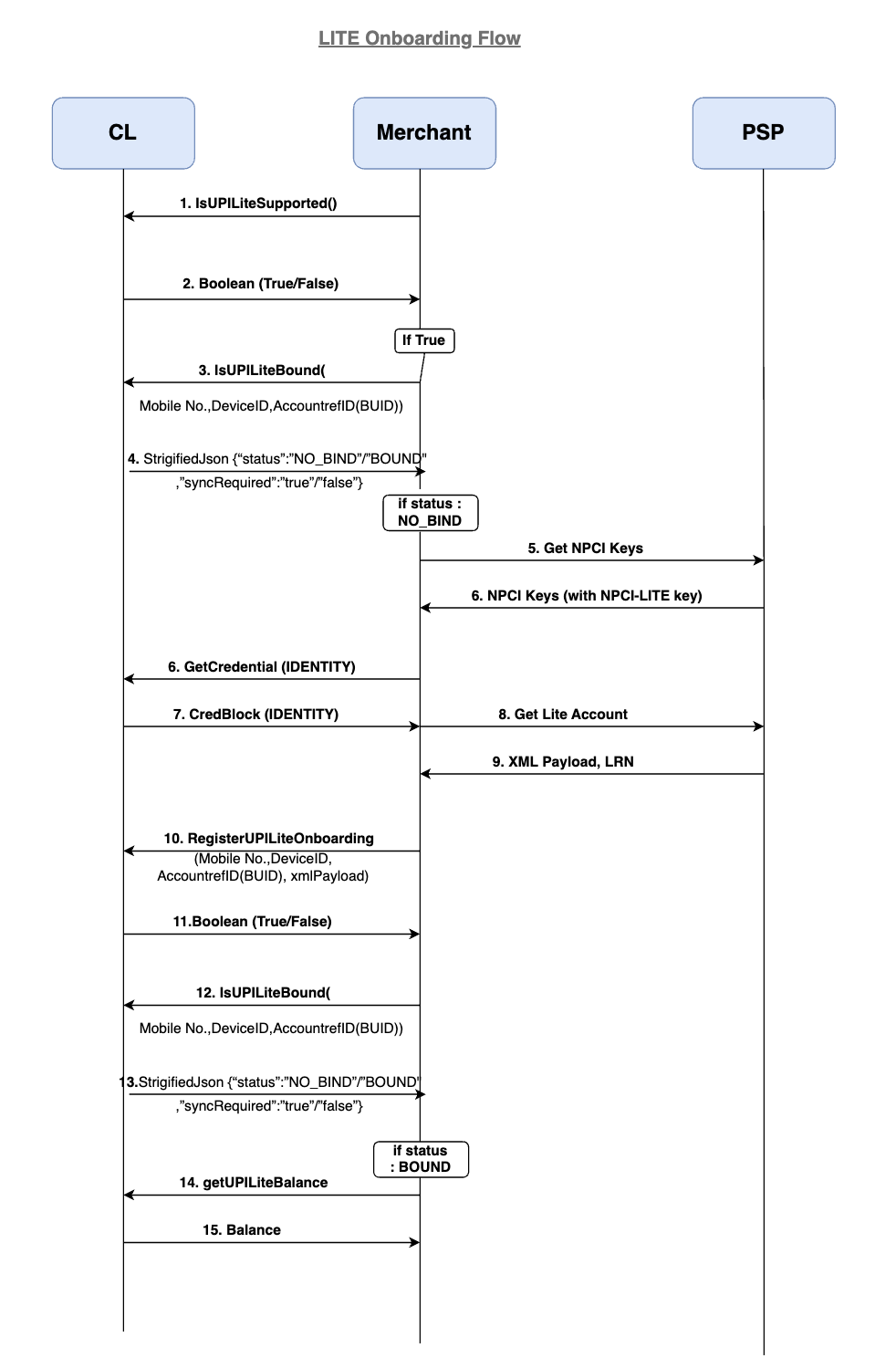
The process commences by initially verifying the eligibility of the device's operating system for the LITE service. Once an existing UPI user takes the step to activate the Lite service, the Payment Service Provider (PSP) initiates the ReqListKeys API. This is followed by a mandatory initial top-up or adding of funds for the Lite service.
The validation process begins when the merchant application requests the IsUPILiteSupported API from the Common Library (CL), which responds with a Boolean value (either True or False). If the response is True, the merchant application then calls the IsUPILiteBound API with the mobile number, DeviceId, and AccountrefId (BUID) as parameters. The CL, in turn, provides the Bind status as either NO_BIND or BOUND.
In the event that the status is NO_BIND, the merchant application proceeds to request the Get NPCI Keys API, including the 'x-api-version': '1' parameter, which retrieves the LITE keys. Subsequently, the merchant application makes a request for GetCredentials with the type set to IDENTITY, and the CL responds with the Credblock. Additionally, the merchant application requests GetLITEAccount from the PSP, which results in the PSP providing an XML Payload and LRN.
Following this, the merchant application utilizes the RegisterUPILiteOnboarding API along with the Mobile number, DeviceId, AccountrefId, and XML Payload. The CL then returns a Boolean value (True or False). Subsequently, the merchant application once again calls IsUPILiteBound, and based on the provided parameters, the CL responds with the status as BOUND.
As a result, the device completes the LITE onboarding process.
 Have questions?