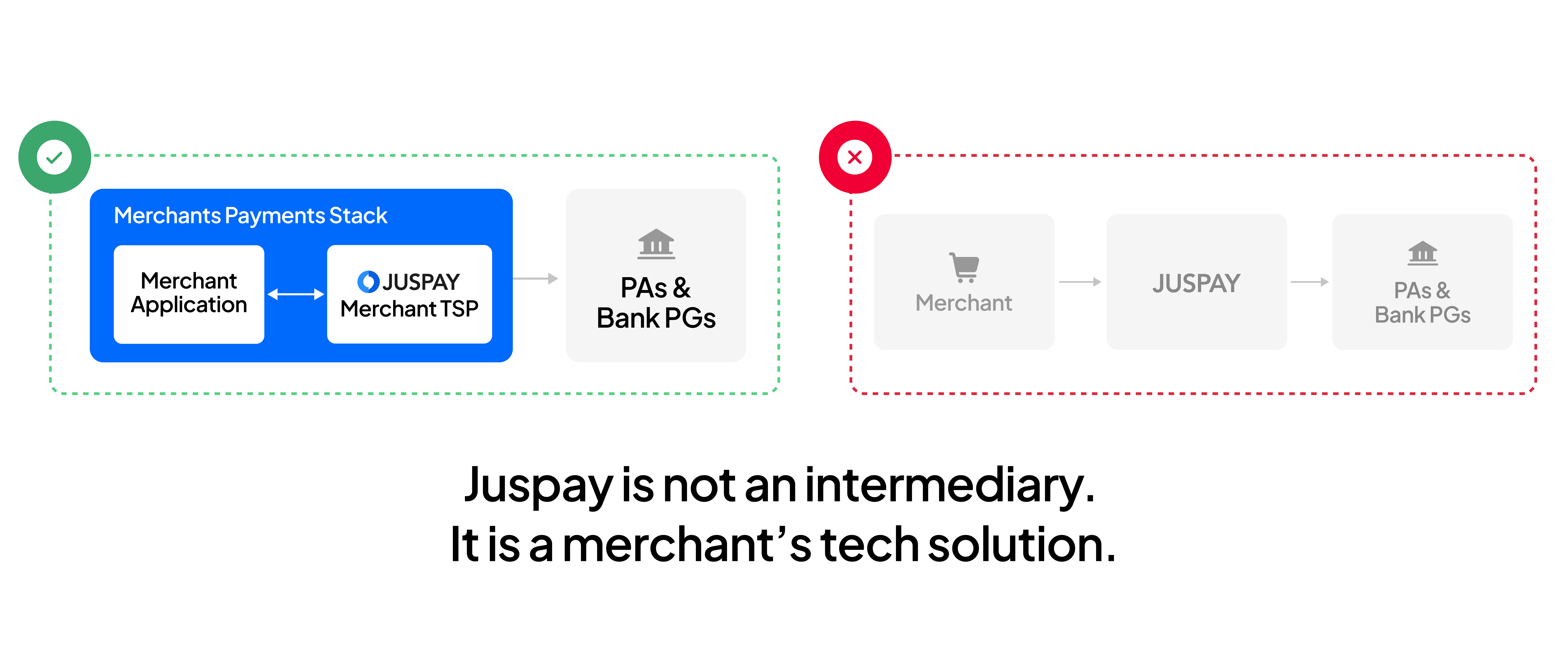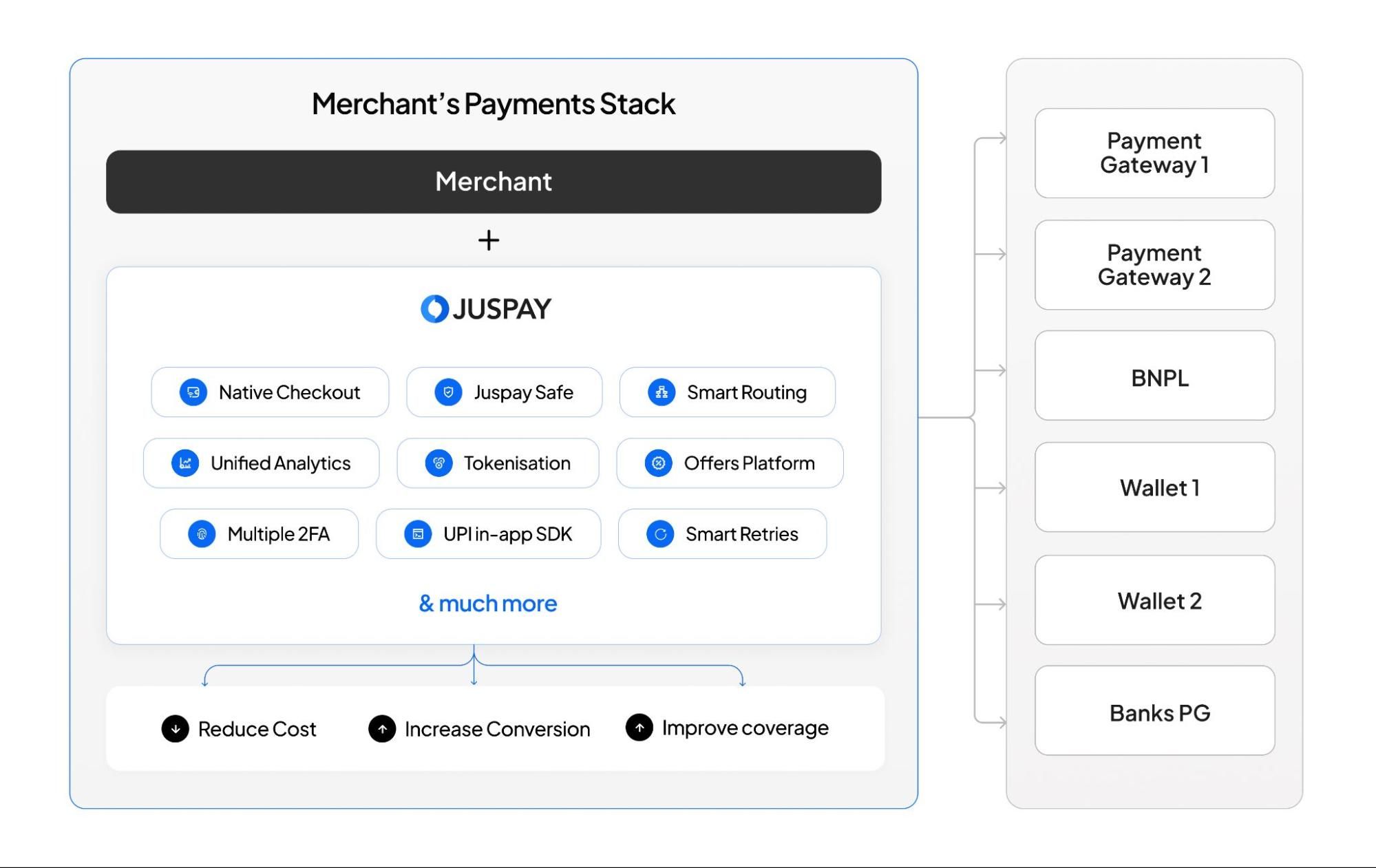
















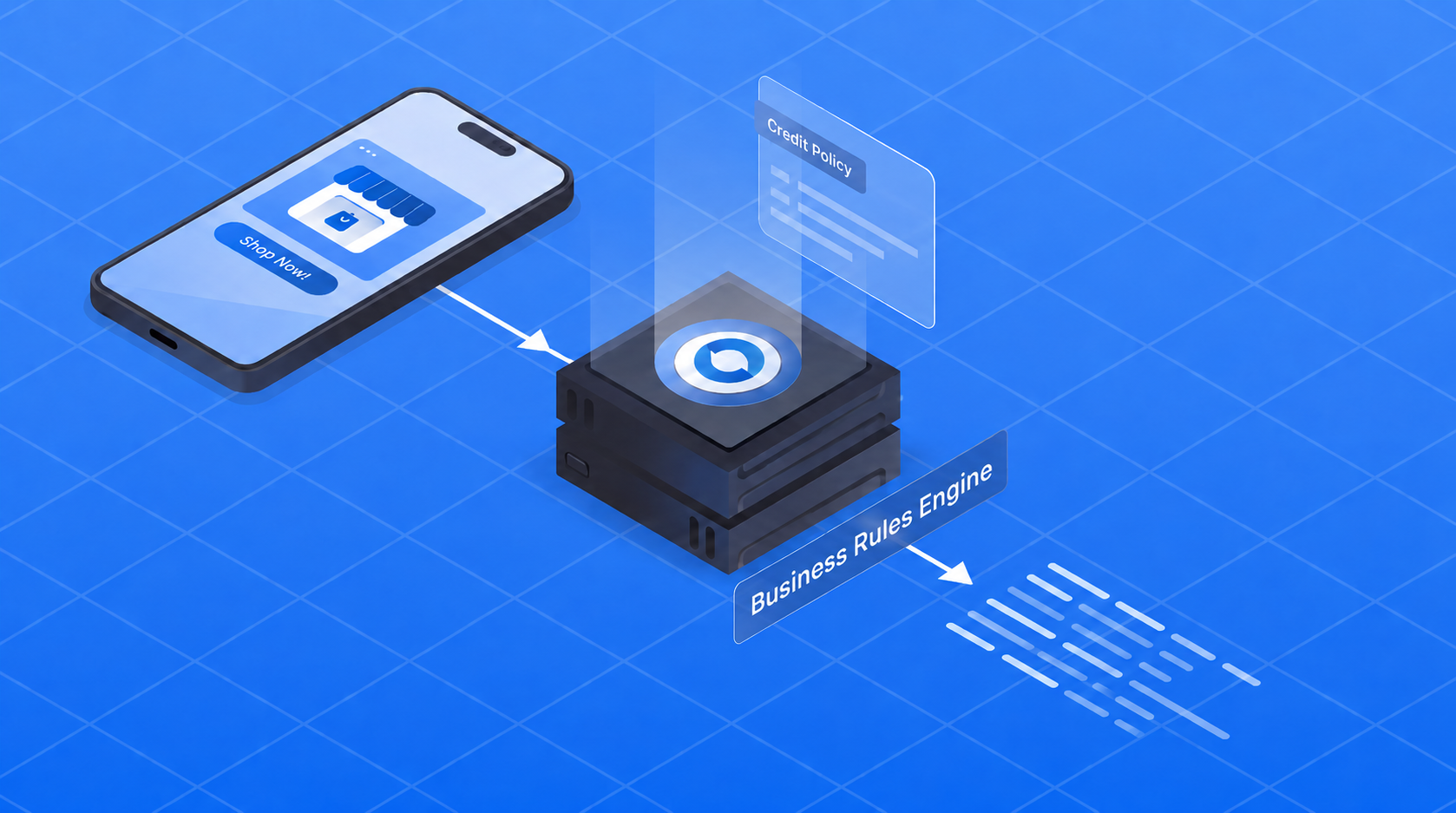
A business rules engine (BRE) in lending is software that evaluates every incoming applicant against a lender's credit policy. It decides whether to qualify, decline, or route the application before it ever reaches the underwriting engine.
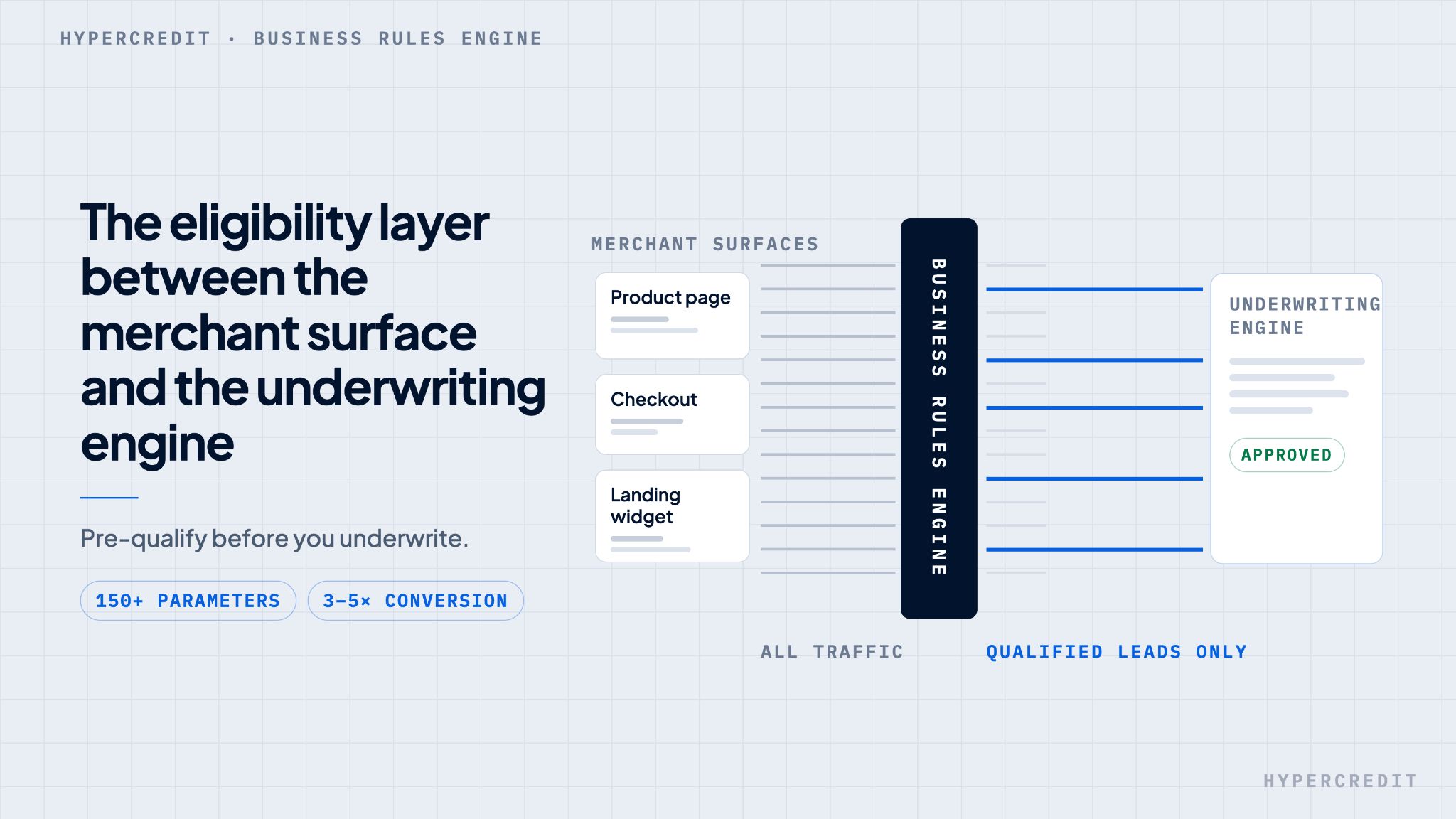
In embedded finance, the BRE works early in the origination process. It sits right at the merchant surface where a shopper first sees a financing option. The software filters and routes traffic to make sure the underwriting stack only reviews high-quality leads.
Inside Juspay's HyperCredit, the BRE acts as a pre-qualification layer to decide a shopper's eligibility right on the product page. This approach helps lift approval rates while also cutting underwriting costs.
Why has eligibility moved upstream in embedded lending?
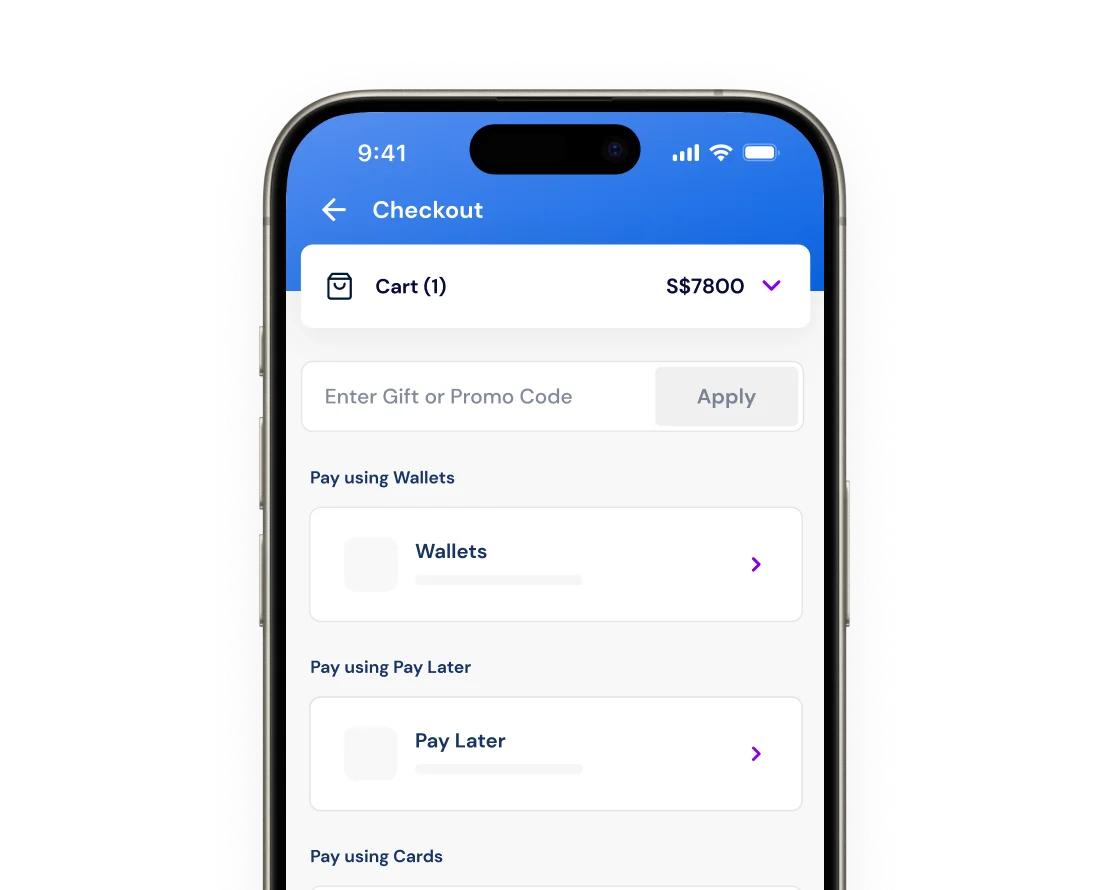
In embedded lending, eligibility decisions have moved upstream. Instead of taking place in the lender's back office, these decisions now happen the exact moment a shopper sees a financing widget at checkout. Financing is no longer just a payment method chosen at the end of a transaction. Today, it actively shapes the purchase decision itself. Because of this, the eligibility check must happen right when the buyer's intent forms, rather than after their interest has cooled down.
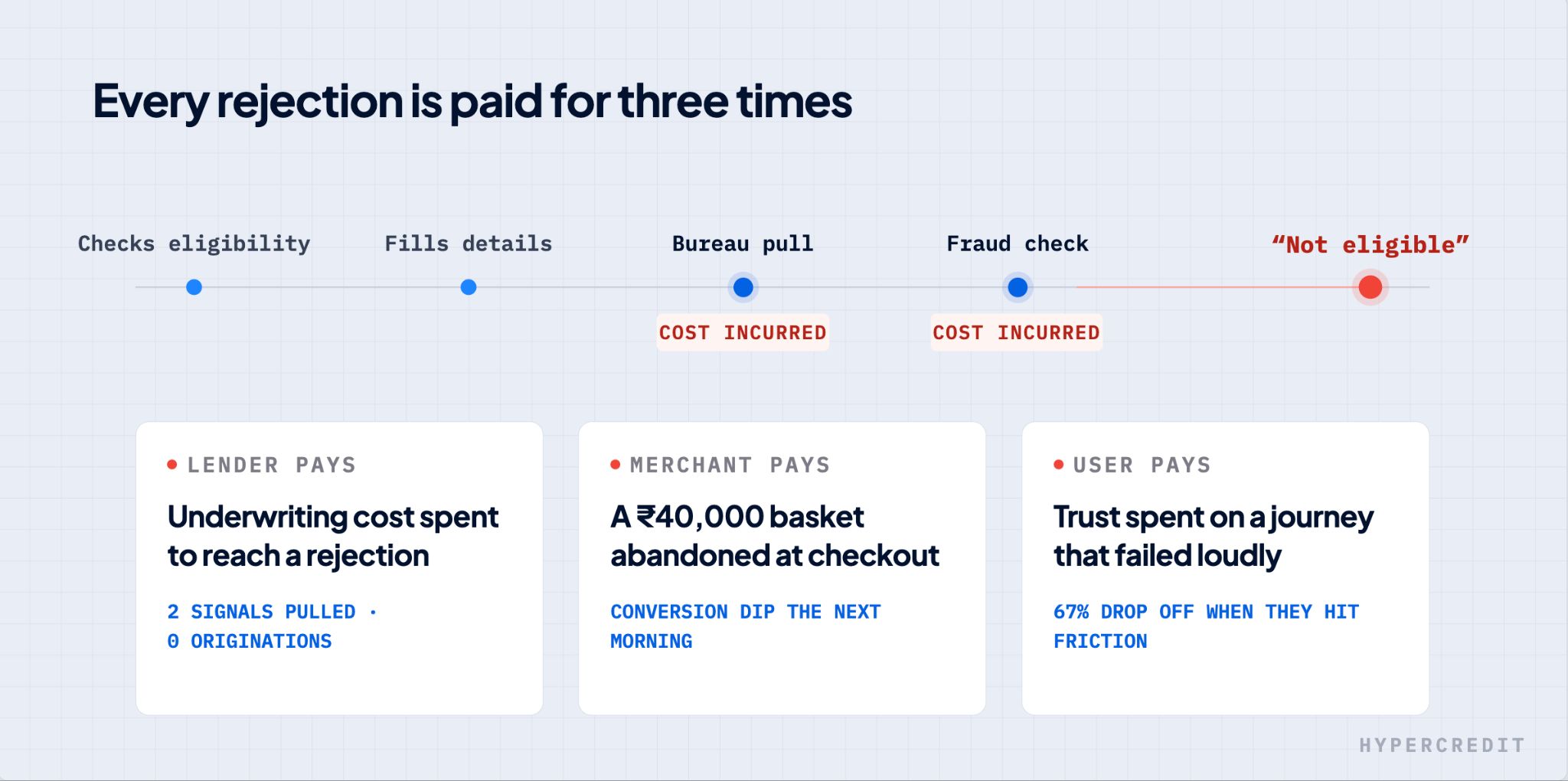
Consider a common scene. It is late on a sale day on a busy e-commerce site. A shopper is three taps into checkout on a ₹40,000 phone. They tap "Check eligibility" to finance the purchase, enter a few details, a bureau gets pulled, an underwriting engine fires, and they are declined. They close the tab. The next morning, the merchant's growth team sees a conversion dip, the lender's risk team sees approval rates slip, and the lender has already paid the underwriting cost. Both parties lose, and the shopper walks away.
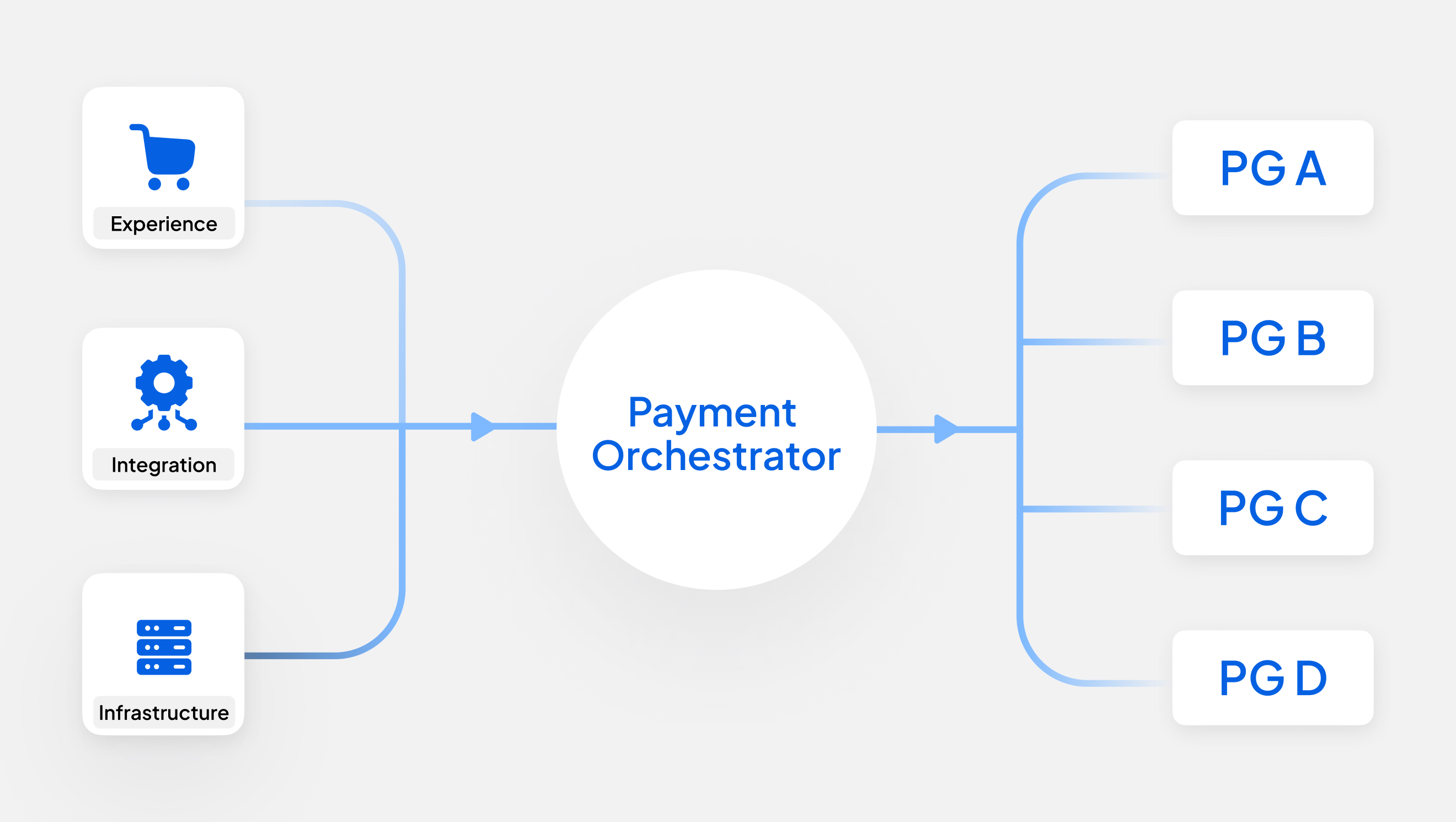
This failure shows a gap in the system. Even though the decision now happens early at the top of the funnel, the underlying technology has not caught up. A modern embedded finance stack needs a dedicated eligibility layer that sits right between the merchant surface and the lender's underwriting engine. Providing this layer is exactly the job of a business rules engine.
The market is pushing hard in this direction. Embedded lending already holds the largest share of India's digital lending market, roughly 35%, precisely because it integrates credit natively into e-commerce checkouts and super-app journeys, according to Nexdigm's India Digital Lending report. Around 67% of digital customers now expect financing offers to arrive pre-filled with existing profile data and decided within seconds, per Global Growth Insights. When the expectation is an instant answer at the point of intent, a slow or wrongly placed eligibility check is a lost sale.
What is a business rules engine (BRE) in lending?
Business rules engine (BRE): software that evaluates every incoming applicant against a lender's configured credit policy and returns one of three outcomes (qualify, decline, or route to a specific lender) without that policy living inside the merchant's system. In embedded finance, the BRE sits upstream of origination: it filters and routes traffic at the moment of purchase, so the underwriting stack only ever sees leads that already fit the policy.
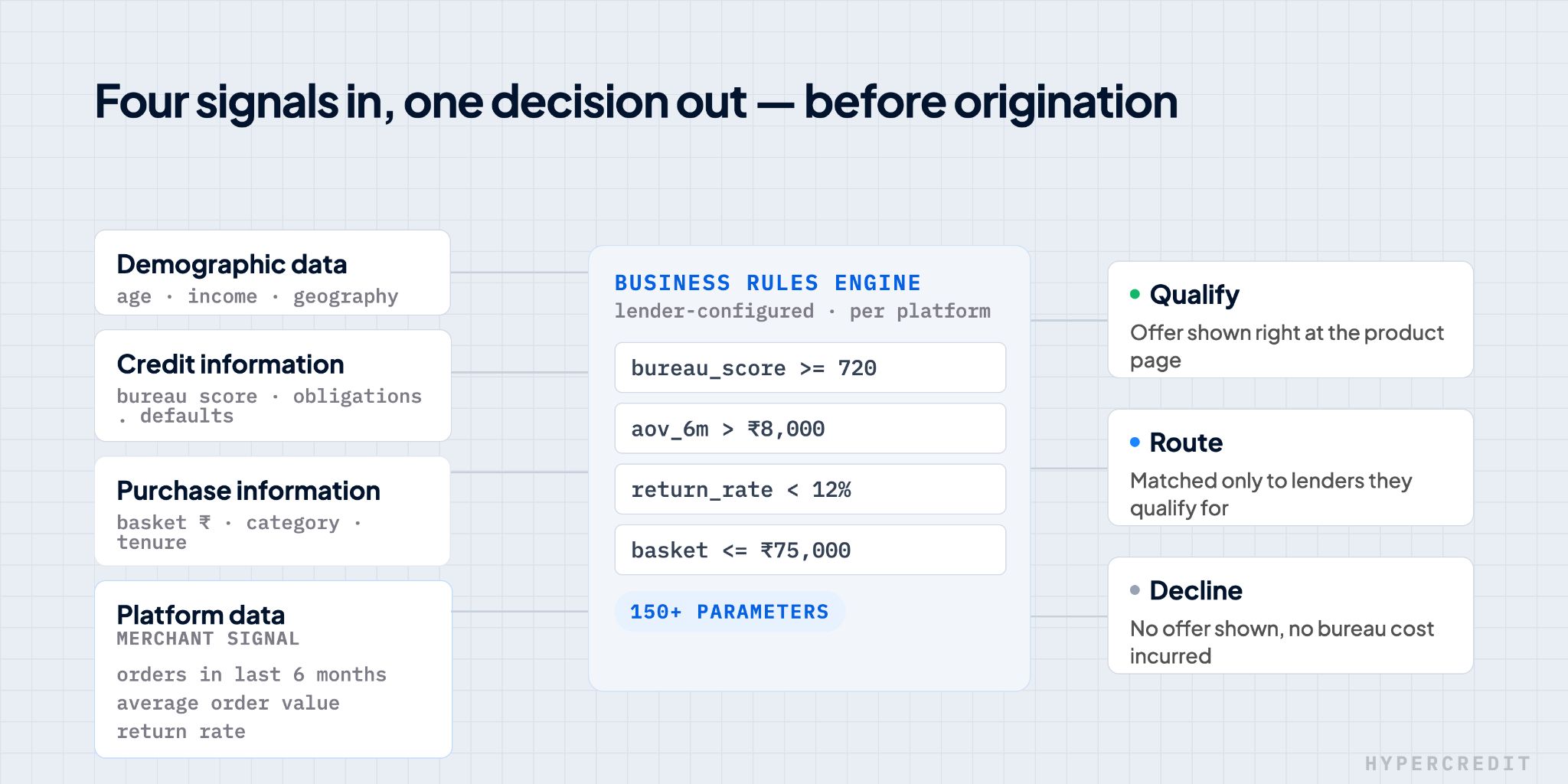
For each lead, the BRE reads four categories of signal:
- Demographic data - the applicant's basic profile information.
- Credit information - the bureau snapshot and credit history.
- Purchase information - what is being bought, the cart value, the financing construct.
- Platform data - merchant-generated signals such as total orders in the last six months, average order value, and return history.
Platform data is the signal most lenders never see in a traditional flow, and it is often the most predictive. It tells a lender whether this is a repeat, high-value customer of the merchant or a first-time visitor with an empty history. The BRE evaluates all four signal types against each lender's pre-defined criteria right at the product page, shaping both the approval chance and the purchase decision in the same instant.
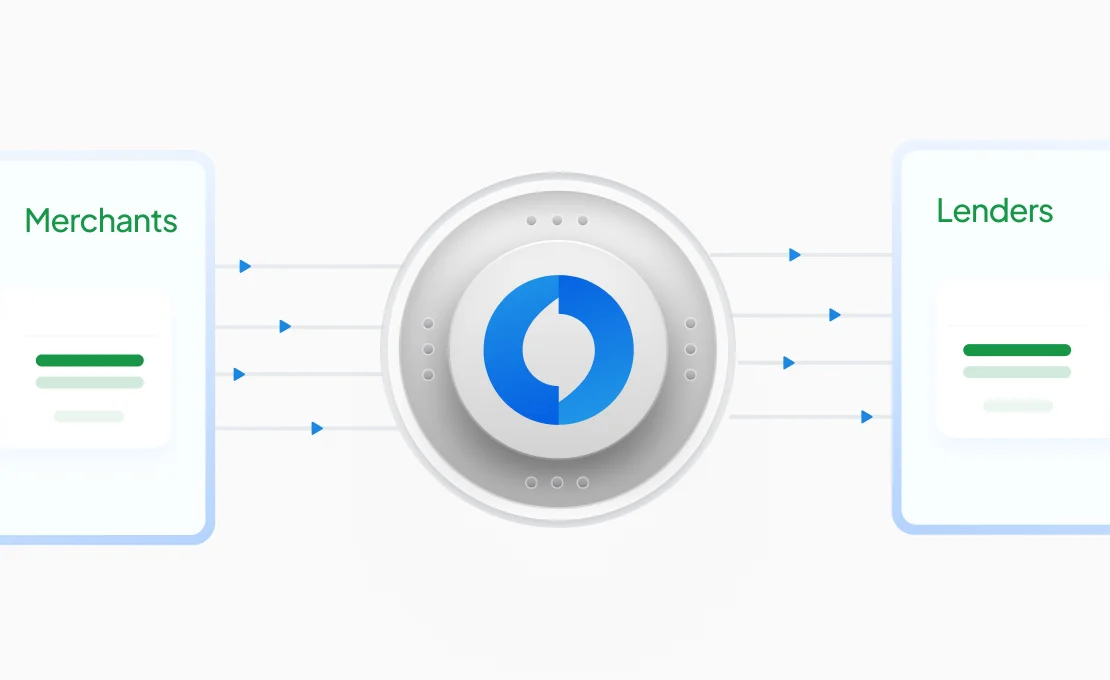
In structural terms, the BRE is the gate that stands between an entire merchant network and a lender's underwriting engine. Everything upstream is traffic; everything downstream is an application worth underwriting.
Pre-qualify before you underwrite: why it changes the economics
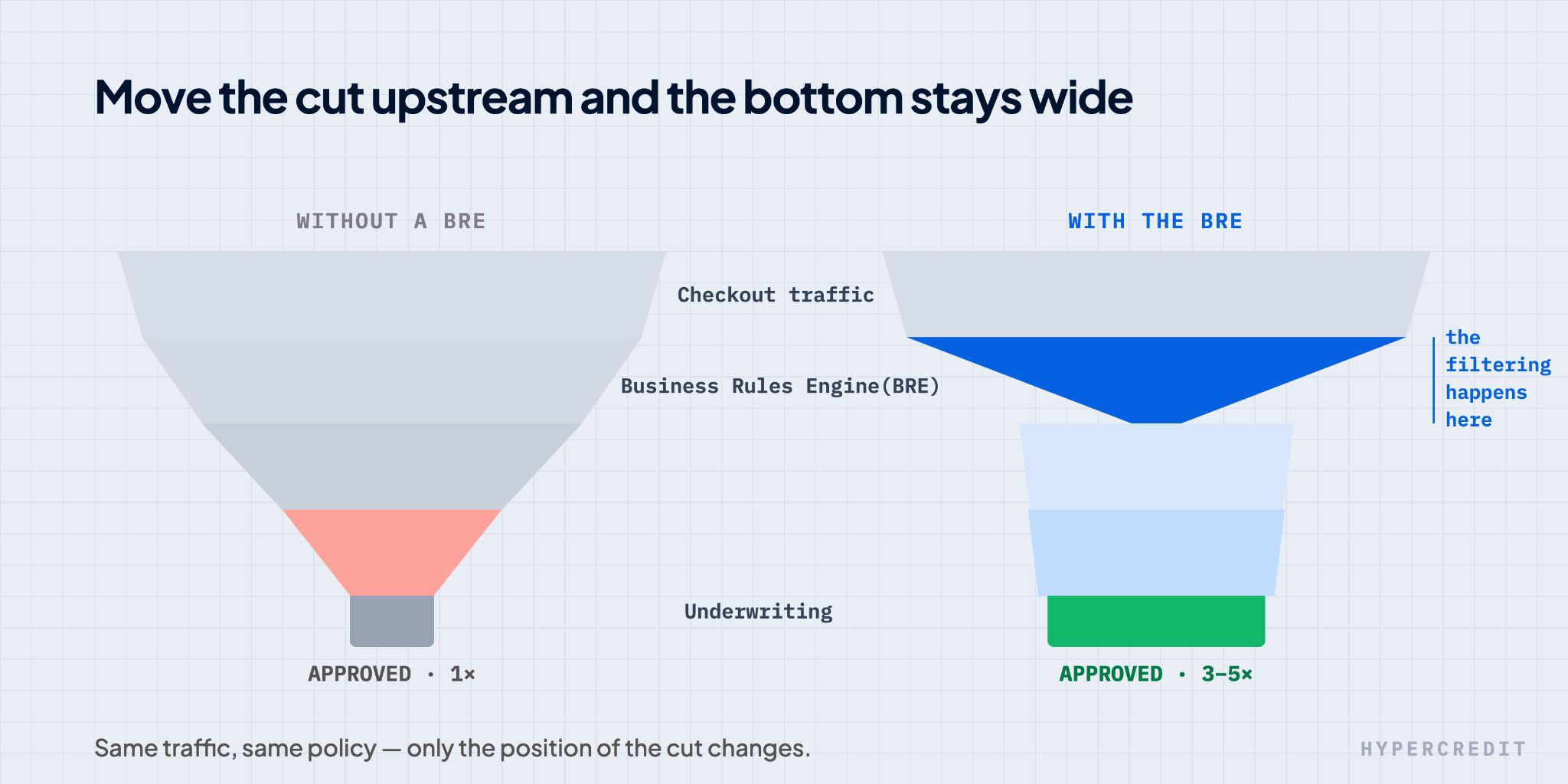
Pre-qualification changes lending economics because it moves the filter before the cost. Instead of pushing raw checkout traffic at every lender and letting each underwriting engine spend to reach a decision, the BRE checks each shopper against the lender's eligibility rules first and surfaces only the lenders that genuinely pre-qualify that shopper. The underwriting engine then assesses a stream of already-filtered leads rather than a flood of curiosity.
This process does not replace underwriting, but it heavily boosts its returns. A BRE is not a credit model and does not make the final lending decision. Instead, it is a routing and eligibility layer that decides who is worth underwriting. The underwriting engine still owns the final approve or decline call on every applicant it sees. If you confuse the two, the BRE ends up getting blamed for decisions it was never designed to make.
The benefits show up in two key numbers that every lending team watches. Because only high-quality leads reach the core system, the underwriting funnel improves and underwriting costs fall sharply. In fact, HyperCredit sees pre-qualification cut the cost per origination by about half. Also, pre-qualified leads convert at roughly three to five times the rate of unqualified ones in HyperCredit deployments. This happens because a shopper who only sees offers they actually qualify for- will rarely hit a roadblock a few minutes into the process.
Independent market data shows the exact same trend. Point-of-sale financing lifts checkout conversion by up to 20%, according to Technavio's Digital Lending analysis. Additionally, RBC Capital Markets found that buy-now-pay-later options raise conversion rates by 20 to 30% and increase average ticket sizes by 30 to 50%. According to Global Growth Insights, roughly 55% of merchants report that embedded lending cuts checkout abandonment by more than 10%. Ultimately, pre-qualification is the key that makes these growth numbers reliable rather than just accidental.
The hidden cost of the wrong "no"
The wrong "no" in embedded lending is expensive because three parties pay for it at once. Every time a shopper is told "you're not eligible" after a bureau pull, after a fraud check fires, after they have already invested intent, the cost lands three ways. The lender pays for underwriting spent only to reach a rejection. The merchant pays in lost conversion and a bruised brand. And the shopper pays in trust, then drops off.
A BRE fixes this cost problem right from the start. It pre-qualifies every shopper against the lender's criteria before their application ever reaches the core system. This ensures that a shopper only sees options from lenders they actually qualify for.
If no lenders are a match, the system simply hides the credit offer instead of rejecting the user late in the checkout process. As a result, the shoppers who finally make it to the underwriting engine are already filtered to policy, meaning far more of them get approved.
The stakes are highest when shopping volume is at its peak. During festive sales, shopper traffic shoots up. If a lender runs every single application through the underwriting process, they end up paying money just to reject people. This happens exactly when their infrastructure is under the most strain and every rejection is highly visible to customers.
A BRE fixes this by filtering applications upstream, earlier in the process. This ensures the core underwriting system only works on volume that is actually worth underwriting, rather than wasting time and resources on shoppers who are just curious.
What makes a lender-grade BRE?
A lender-grade BRE is one where every lead is evaluated against the lender's own configured rules before it reaches the lender's core system, with the rules kept private from the merchant. Each lead carries four inputs into that evaluation: PII, a bureau snapshot, product context, and platform signals. Lenders own their rules. Merchants own their funnel. The BRE owns the routing between them, applying policy across more than 150 configurable parameters in HyperCredit. Four principles separate a lender-grade BRE from a generic rules layer:
- Lender-controlled. Rules live in the lender's dashboard, private from merchants, with an architecture that allows encryption. This matters under the Reserve Bank of India's digital lending guidelines, which place clear responsibility on the lending entity and restrict how credit policy and borrower data are handled.
- Platform-aware. Rules can be defined per platform and configured against the data each platform generates, so the same policy behaves differently at a quick-commerce app than at a premium retailer.
- Explainable. Every decision can be traced back to the exact rule that triggered it. The system can also be queried to explain the outcome for any individual lead. This makes the process a transparent glass box instead of a hidden black box.
- Composable. Eligibility rules can be updated on the fly, shadow-tested, and verified for conversion uplift before they ship to real shoppers.
Five BRE capabilities, mapped to outcomes
A lender-grade BRE earns its place through capabilities that map directly to business outcomes, not features for their own sake. The table below summarises five core capabilities of HyperCredit's BRE and the outcome each one drives; the sections that follow explain how they work.
| Capability | What it does | Outcome |
| Rule configuration per merchant, industry, product | Control your credit policy across many surfaces, applied contextually | Policy customized to each platform in minutes. |
| Shadow testing on live profiles | Run a new rule alongside the current one on live traffic, without affecting the funnel | Policy change becomes an experiment, not a quarterly debate |
| ETB and pre-qualified whitelisting | Skip redundant verification for existing-to-bank and pre-qualified users | Shorter journey, higher conversion |
| Full-funnel analytics and rule-level audit | Query which rules ran and fired for any order ID | Traceable decisions, faster ops |
| Lender go-live without merchant-side rebuilds | Ship across the merchant network by configuring policy on a dashboard | Weeks to launch, not months |
Rule configuration, per merchant, per industry, per product. A lender configures a credit policy once and applies it contextually across surfaces. The same lender can run one rule set for Pay-in-3 at quick commerce and another for premium financing at an insurer, without rebuilding integrations for each.
Shadow testing, at run time, on live profiles. Shadow testing turns a policy change from a slow quarterly debate into a simple experiment. A lender can run a proposed rule alongside their current one using live customer traffic. This lets them see exactly how the new rule would perform with each merchant's specific demographic. Best of all, they can do this without affecting the active funnel or changing a single real decision.
ETB and pre-qualified whitelisting. Lenders can set up their systems so that existing-to-bank (ETB) and pre-qualified users can skip repetitive verification steps. This means the shopper saves time by skipping steps, and the lender avoids running a credit bureau pull on a customer they already know. It also helps the lender secure a priority spot at checkout.
This approach directly prevents customer drop-off. Reducing drop-off is critical right now because the standard expectation across embedded lending is to provide a pre-filled offer that is decisioned in just seconds.
Full-funnel analytics and rule-level audit. Every decision the BRE makes is queryable. For any order ID, an ops team can see which rules ran, which fired, and why. This is what turns a black box into a glass box, and it is what regulators and risk committees increasingly expect.
Lender go-live without merchant-side rebuilds. A lender ships across an entire merchant network by configuring rules in a dashboard, not by integrating separately with each merchant. That is the difference between launching embedded financing in weeks and launching it in months.
Where BRE implementations commonly fall short
A business rules engine is not a cure for a weak credit policy or a substitute for underwriting, and treating it as either is the most common way these implementations disappoint. The engine executes the rules it is given; it does not invent good ones. A few failure modes recur:
- Over-tight rules starve the funnel. If a BRE is set up too strictly, it will decline shoppers who would have actually completed the purchase and repaid the loan. This quietly limits business growth. This is exactly why shadow testing is so important. It allows you to test a new rule using live customer traffic before you officially launch it, rather than waiting to see if your approval rates drop.
- Treating the BRE as the underwriter. The BRE is only meant to pre-qualify users. The actual underwriting engine is the one that makes the final decision. If you put the final credit decision logic into the rules layer, it confuses responsibilities and makes it much harder to figure out why a shopper was wrongly rejected.
- Stale platform signals. Platform data, like average order value and a shopper's return history, is only useful if it is up to date. If the merchant data feed is delayed, the BRE ends up making routing decisions based on outdated information about the shopper.
- Opaque rules that can't be audited. A rules layer fails if its decisions cannot be traced back to a specific rule that was triggered. You need to know exactly what happened the moment a regulator, a merchant, or an operations team asks why a specific shopper was declined. This kind of explainability is strictly required under India's digital lending rules.
Naming these limits points out the difference between a BRE that lifts approval rates and one that silently suppresses them.
What a BRE means for lenders and merchants
A BRE creates value on both sides of the marketplace at the same time. This is why it works as a piece of shared infrastructure rather than a tool for just one party. The table below shows what each side gains. A truly strong BRE ensures that benefits for one side do not come at the cost of the other.
| For Lenders | For Merchants |
| Brings in better leads and lowers OpEx per origination. | Drives higher checkout conversion. |
| Speeds up policy updates through shadow testing. | Results in fewer rejected customer journeys that can damage the brand. |
| Enables distribution across a whole merchant network from a single dashboard. | Ensures real credit offers are shown to real shoppers. |
| Makes sure the core underwriting system only spends time on volume actually worth underwriting. | Creates an AOV (Average Order Value) lift that turns financing into a powerful growth lever instead of just a checkout feature. |
Embedded finance in India will not be won simply by having the largest lending book or the biggest merchant funnel. Instead, it will be won through higher approval rates, a lower cost to originate, and a digital journey that respects the shopper's time reliably even at festive-season scale. The BRE is the crucial layer where all of this work gets done.
Juspay orchestrates payments across more than 150 countries and processes over 300 million transactions a day. The company built HyperCredit on the exact same principle that runs its payments stack. The goal is to make intelligent decisions at the edge so the expensive core system only does work that actually pays off.
Key Takeaways
- A business rules engine (BRE) is the pre-qualification layer in embedded lending. It evaluates each applicant against a lender's policy and returns a decision to qualify, decline, or route the application before it ever reaches underwriting.
- The BRE reads four types of signals: demographic data, credit information, purchase information, and merchant platform data (such as orders, AOV, and returns). Platform data is often the most predictive indicator, which is a signal that traditional flows usually miss.
- Pre-qualifying before underwriting improves the funnel and cuts the cost per origination. For example, HyperCredit sees pre-qualified leads convert at roughly 3 to 5 times the rate of unqualified ones.
- The wrong "no" costs three parties at once. It wastes the lender's underwriting spend, hurts the merchant's conversion rate, and breaks the shopper's trust. A BRE prevents this by hiding offers a shopper will not qualify for instead of failing them mid-checkout.
- A lender-grade BRE is lender-controlled, platform-aware, explainable, and composable. This means the rules are kept private to the lender, and every decision is fully traceable to the specific rule that was triggered.
- A BRE is not an underwriter, nor is it a fix for a weak credit policy. Its most common failure modes include over-tight rules, stale signals, and un-auditable logic.
Frequently Asked Questions
What is a business rules engine in lending?
A business rules engine (BRE) in lending is software that evaluates each loan applicant against a lender's configured credit policy and returns one of three outcomes before the application reaches underwriting: qualify, decline, or route to a specific lender. In embedded finance it runs at the checkout or product page, filtering traffic so the underwriting engine only assesses leads that already fit the lender's rules.
How is a business rules engine different from an underwriting engine?
A business rules engine focuses on pre-qualifying applicants, while an underwriting engine is the tool that makes the final decision. The BRE acts as a fast eligibility and routing layer. It filters checkout traffic upstream by checking shoppers against set rules to figure out who is actually worth assessing.
After that, the underwriting engine sits downstream and makes the final approve-or-decline credit decision on those filtered leads. The BRE is not a credit model and it does not replace the underwriting process. Instead, it simply reduces the volume of applications that the underwriting engine has to process.
Why does pre-qualification matter in embedded finance?
Pre-qualification matters because it moves the eligibility filter before the underwriting cost. Instead of every shopper triggering a bureau pull and a full assessment, the BRE surfaces only the lenders a shopper genuinely qualifies for. This lifts approval rates, reduces cost per origination, and prevents the mid-checkout rejection that drives shoppers away. Pre-qualified leads convert at several times the rate of unqualified ones.
What data does a business rules engine use to pre-qualify a lead?
A business rules engine pre-qualifies using four signal types: the applicant's demographic data, their credit information from a bureau snapshot, purchase information such as cart value and financing construct, and platform data from the merchant. Platform data, which covers signals like total orders over six months, average order value, and return history, is what traditional lending flows rarely see, and it is often the most predictive of who will convert and repay.
How does Juspay's HyperCredit BRE help lenders and merchants?
Juspay's HyperCredit BRE gives lenders a lender-controlled, encryptable rules dashboard that pre-qualifies leads across 150+ parameters before they reach underwriting, and lets a lender go live across an entire merchant network without per-merchant integration. Lenders get lower origination cost and faster policy iteration through shadow testing; merchants get higher checkout conversion, fewer rejected journeys, and an average-order-value lift.