










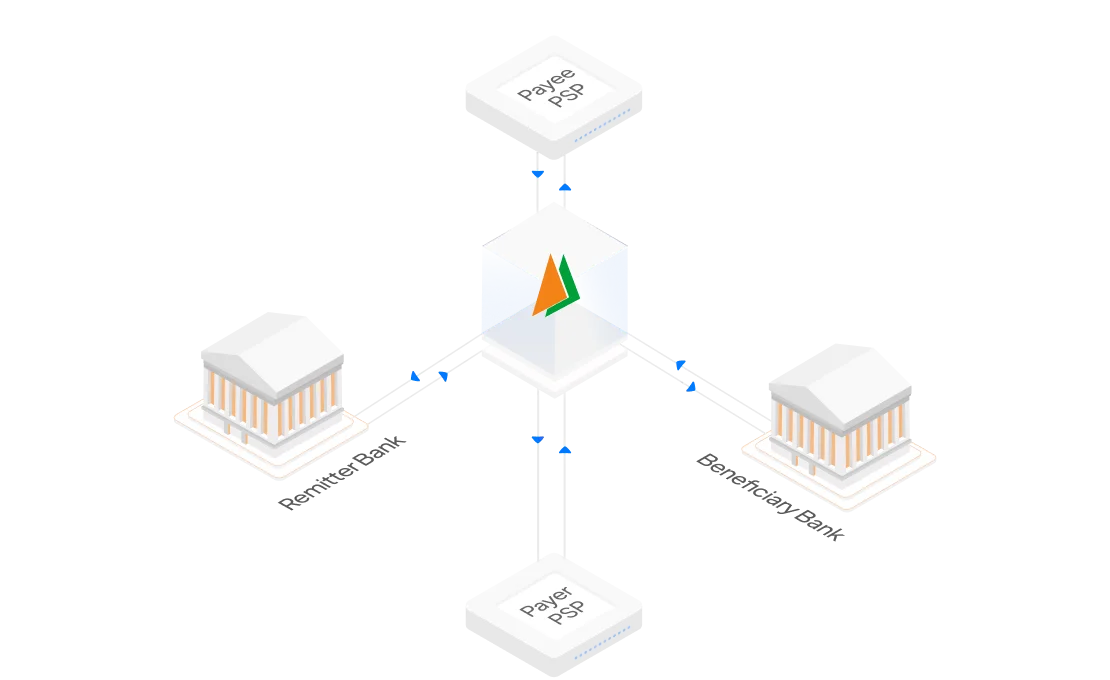



The way credit reaches borrowers in India is undergoing a quiet but profound transformation. With over 23 billion UPI transactions processed monthly, the Unified Payments Interface has become the backbone of India's digital economy. The introduction of Credit Line on UPI by the regulators in September 2023 takes this a step further by embedding credit directly into the payments layer. For lending institutions, this is not just a product feature. It is a new credit distribution paradigm worth understanding deeply.
What Is Credit Line on UPI?
A Credit Line on UPI (also referred to as CLOU) is a pre-sanctioned credit facility issued by a lending institution that is linked directly to a borrower's UPI ID. Once linked, the borrower can make payments using the credit line through any UPI-enabled application, without needing a physical credit card or a separate loan disbursement.
Unlike a traditional loan, which transfers a lump sum to the borrower's account, a credit line on UPI operates on a draw-as-needed basis. The borrower spends up to their approved limit, and repayment happens as per the lender's terms, either at the end of a billing cycle or through scheduled installments.
The credit is accessible the moment a payment is initiated, without requiring additional authentication steps, new apps, or a physical instrument.
Credit Line on UPI vs. Traditional Credit Products
For lending institutions, understanding how CLOU sits within the broader credit product landscape is essential before evaluating its strategic fit.
| Credit Card | Personal Loan | BNPL | Credit Line on UPI | |
| Physical Instrument | Required | Not required | Not required | Not required |
| Disbursement | Pre-loaded limit on card | Lump sum to account | Draw-as-needed | Draw-as-needed |
| Acceptance Channel | POS / online | Bank account | App-specific | QR + Online |
| Merchant Coverage | Card-accepting merchants only | Universal | Platform-specific | UPI merchant network (50M+) |
| Onboarding | Branch / digital | Branch / digital | Fully digital | Fully digital |
| Repayment Flexibility | Monthly billing cycle | Fixed EMI | Monthly billing cycle | Flexible as per lender - Monthly, Fortnightly |
| Target Segment | High Credit Eligibility and Banked | High Credit Eligibility and Banked | Digital-first, younger population | UPI-active, including new-to-credit |
The critical differentiator is distribution reach. A credit card is constrained by card acceptance infrastructure. A personal loan sits in a bank account, detached from spending behaviour. CLOU, by contrast, activates credit at the moment of payment, across every QR code, every UPI handle, and every merchant where UPI is accepted. For institutions looking to serve the next 100 million credit users, that reach is difficult to replicate through any other product.
Why the Market Is Ready
The case for Credit Line on UPI goes beyond enabling the infrastructure itself. It is reinforced by the scale of the UPI ecosystem and the size of India's unmet credit demand.
The UPI Ecosystem Is Enormous and Still Growing: UPI processed over 228 billion transactions in 2025, up from 172 billion in 2024, reflecting a year-on-year volume growth of over 29%. Person-to-merchant (P2M) transactions, the category most relevant to credit line usage, accounted for 63% of total volume. By FY2027, UPI is projected to handle 1 billion transactions per day.
The Credit Gap Is Significant India has over 420 million active UPI users, yet only a smaller segment of individuals hold a credit card as of 2025. This gap reflects a broader challenge: millions of consumers, gig workers, blue-collar workers, self-employed individuals, and small businesses remain underserved by formal credit due to limited credit histories, irregular income patterns, or the high cost of reaching and servicing them through traditional credit channels. Credit Line on UPI creates a pathway to extend formal credit through payment infrastructure that users already trust and engage with daily.
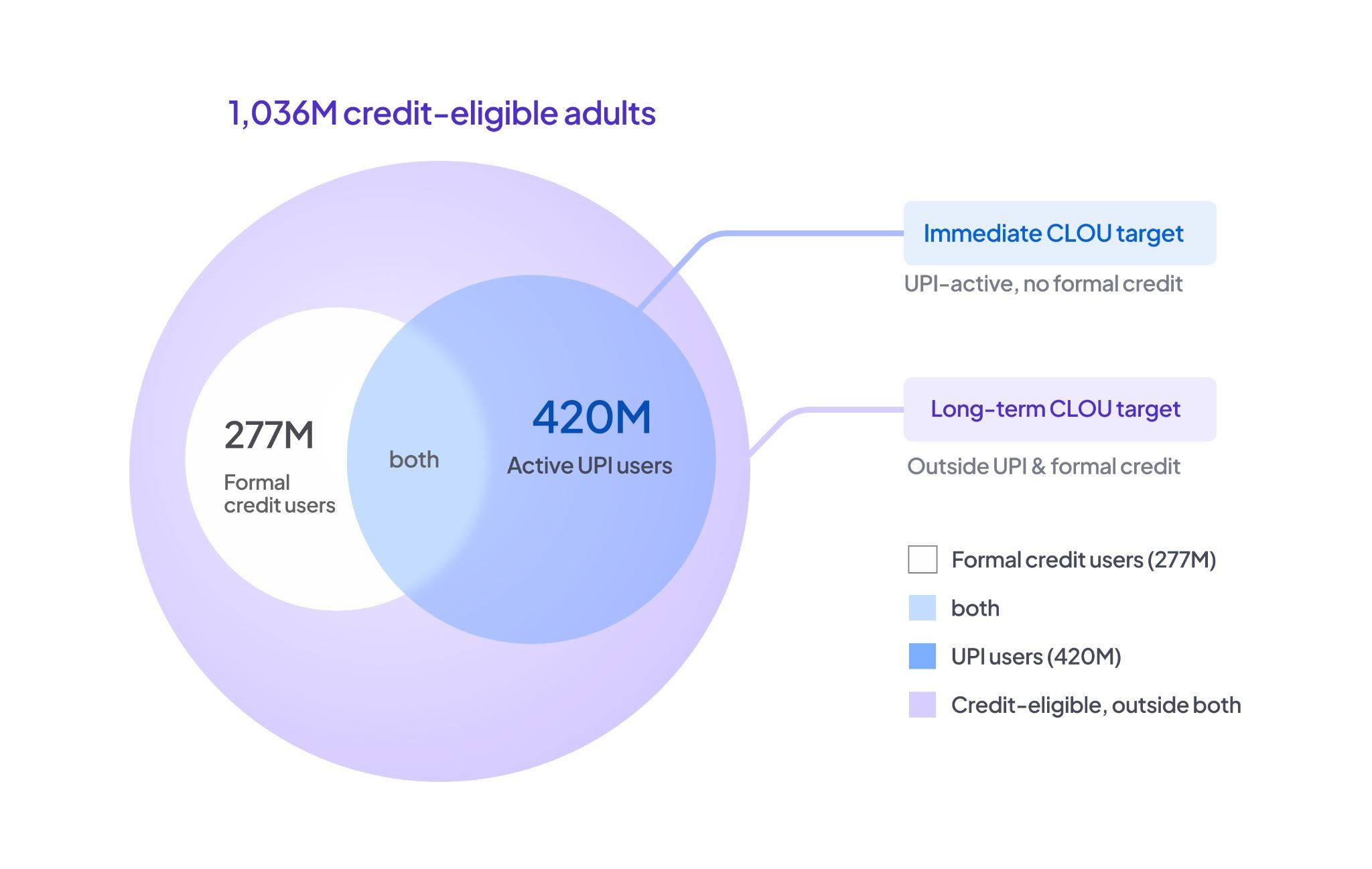
Credit Penetration Is Rising, But Unevenly Credit card penetration in India grew over 60% in the three years to 2024, largely concentrated in metro markets. Tier 2 and Tier 3 cities, which are driving the next wave of UPI adoption, remain significantly underpenetrated from a credit standpoint. For lending institutions, Credit Line on UPI offers a scalable way to expand reach into these segments without the cost and complexity of traditional card issuance.
The Credit-on-UPI Volume Is Building Credit card transactions on UPI already exceed ₹10,000 crore monthly with average ticket size remaining around ₹1000, favoring small-ticket, daily-use spending. As the adoption for CLOU deepens this number is expected to scale materially.
For lending institutions, this presents the opportunity to reach borrowers early, build relationships and credit assets at scale, and establish early advantage before the market becomes crowded.
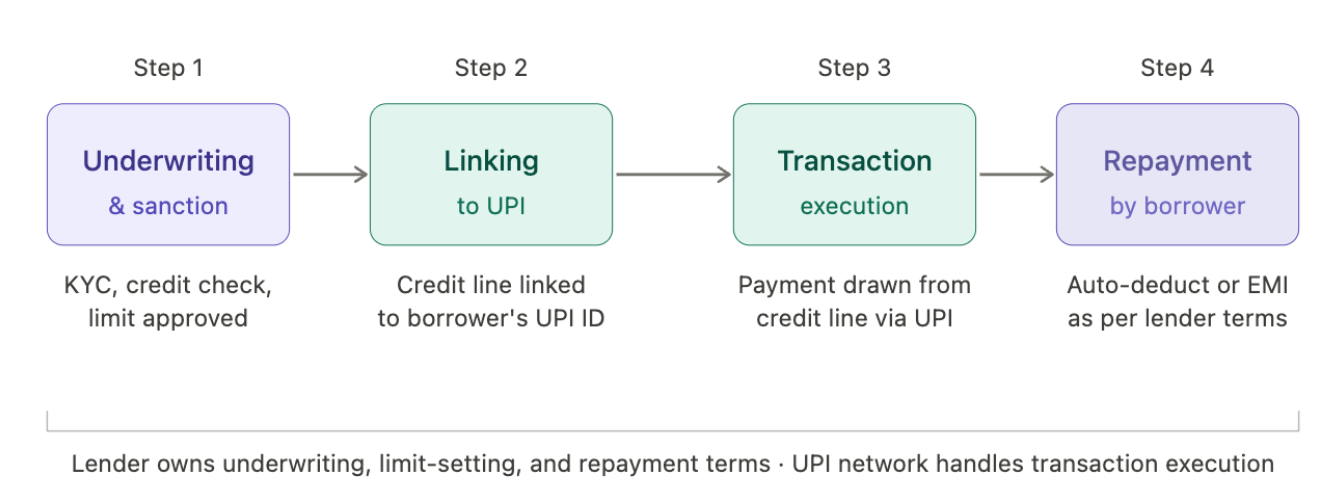
How It Works: End-to-End Flow
Understanding the operational mechanics is essential for institutions evaluating integration or product strategy.
1. Underwriting & Sanction The lending institution assesses the existing users’ income, credit history, KYC documentation, and sanctions a limit to them. They may also offer further loan enhancements backed by collateral.
2. Linking to UPI Once sanctioned, the credit line is linked to the borrower's UPI ID through their preferred UPI application (such as Google Pay, BHIM, Phonepe or Supermoney). The borrower selects the credit line as a payment source when initiating a transaction.
3. Transaction Execution At the point of payment, whether via QR code scan or VPA transfer, the amount is drawn from the credit line rather than the borrower's bank balance. The transaction completes in real time, just like any UPI payment.
4. Repayment Repayment is governed by the lender's terms, either auto-deducted at the end of the cycle (Monthly, Fortnightly, etc.) or through EMI. Since transactions occur within the UPI ecosystem, real-time visibility into spending habits and default signals becomes available to the lender.
Why CLOU Matters for Lending Institutions
A New Credit Distribution Channel
CLOU allows lenders to deploy credit at the point of consumption, not just at the point of application. This shifts the lending model from reactive (customer applies for a loan) to embedded (credit is available where and when the customer spends).
Operational Efficiency
With no physical card issuance or a separate disbursement process and digital KYC, the cost-to-serve is materially lower compared to traditional credit card or personal loan delivery models.
Expanded Reach
By riding on UPI's existing merchant and user network, which spans 350+ million users and over 50 million merchants, lending institutions gain distribution scale without building new acceptance infrastructure, lowering the cost-to-reach materially.
Real-Time Risk Signals
Because spending happens within a regulated, traceable payment network, lenders have access to real-time transaction data that can enhance credit monitoring, early warning systems, and collections processes.
Inclusion at Scale
For small finance banks and institutions targeting Tier 2/3 markets, CLOU provides a digital-first mechanism to extend credit to borrowers who may not hold credit cards but are active UPI users, directly supporting RBI's financial inclusion mandate.
In the next section, we'll cover how Juspay’s CLMS enables lending institutions to build, manage, and scale their Credit Line on UPI offering, from onboarding to repayment.
Key Takeaways
- Credit Line on UPI (CLOU) is a pre-sanctioned credit facility linked directly to a borrower's UPI ID, letting them pay from the credit line through any UPI-enabled app without a physical card or a separate loan disbursement. It was introduced by the regulators in September 2023.
- Unlike a traditional loan that transfers a lump sum, CLOU operates on a draw-as-needed basis, with credit accessible the moment a payment is initiated and repayment governed by the lender's terms, either at billing cycle end or through installments.
- The key differentiator is distribution reach: CLOU activates credit at the point of payment across the UPI merchant network, whereas a credit card is limited to card-accepting merchants and a personal loan sits detached from spending behaviour.
- The market is ready because of scale and unmet demand: UPI processed over 228 billion transactions in 2025 (up over 29% year-on-year), P2M made up 63% of volume, and while India has over 420 million active UPI users, only around 50-60 million hold a credit card.
- For lending institutions, CLOU offers a new embedded credit distribution channel, lower cost-to-serve through digital onboarding, expanded reach across UPI's user and merchant network, real-time risk signals from traceable transactions, and a route to financial inclusion in Tier 2 and Tier 3 markets.
Frequently Asked Questions
What is a Credit Line on UPI (CLOU)?
A Credit Line on UPI is a pre-sanctioned credit facility issued by a lending institution and linked directly to a borrower's UPI ID. Once linked, the borrower can make payments using the credit line through any UPI-enabled application, without needing a physical credit card or a separate loan disbursement.
How is a Credit Line on UPI different from a traditional loan?
Unlike a traditional loan, which transfers a lump sum to the borrower's account, a credit line on UPI operates on a draw-as-needed basis. The borrower spends up to their approved limit, and repayment happens as per the lender's terms, either at the end of a billing cycle or through scheduled installments.
How does a Credit Line on UPI work end-to-end?
The lending institution underwrites the user and sanctions a limit, then the credit line is linked to the borrower's UPI ID through their preferred UPI app. At the point of payment, via QR scan or VPA transfer, the amount is drawn from the credit line rather than the bank balance, and repayment is auto-deducted at cycle end or through EMI as per the lender's terms.
When was the Credit Line on UPI introduced?
Credit Line on UPI was introduced by the regulators in September 2023. It embeds credit directly into the payments layer, building on the Unified Payments Interface, which processes over 23 billion transactions monthly and has become the backbone of India's digital economy.
Why is Credit Line on UPI significant for closing India's credit gap?
India has over 420 million active UPI users, yet only around 50-60 million individuals hold a credit card as of 2025. Millions of consumers, gig workers, blue-collar workers, self-employed individuals, and small businesses remain underserved by formal credit. Credit Line on UPI creates a pathway to extend formal credit through payment infrastructure that users already trust and use daily.
What advantages does Credit Line on UPI offer lending institutions?
CLOU lets lenders deploy credit at the point of consumption rather than only at the point of application, shifting from a reactive to an embedded model. It also lowers cost-to-serve by removing physical card issuance and separate disbursement, expands reach across UPI's network of 350+ million users and over 50 million merchants, and provides real-time risk signals from traceable transactions.