












A payment vault is a secure, PCI-compliant database that stores customer payment credentials as tokens instead of raw card numbers, so a merchant can charge a saved card without ever holding the sensitive data itself. Card details enter the vault once and get replaced by a token with no intrinsic value, and that token drives every future charge, renewal, and one-click checkout. Vaulting reduces PCI scope and shrinks breach exposure. When the vault is independent of any single processor, it also lets merchants route each transaction to the provider most likely to approve it. Juspay operates a payment vault as part of its orchestration layer across 150+ countries.
What is a payment vault and how does it work?
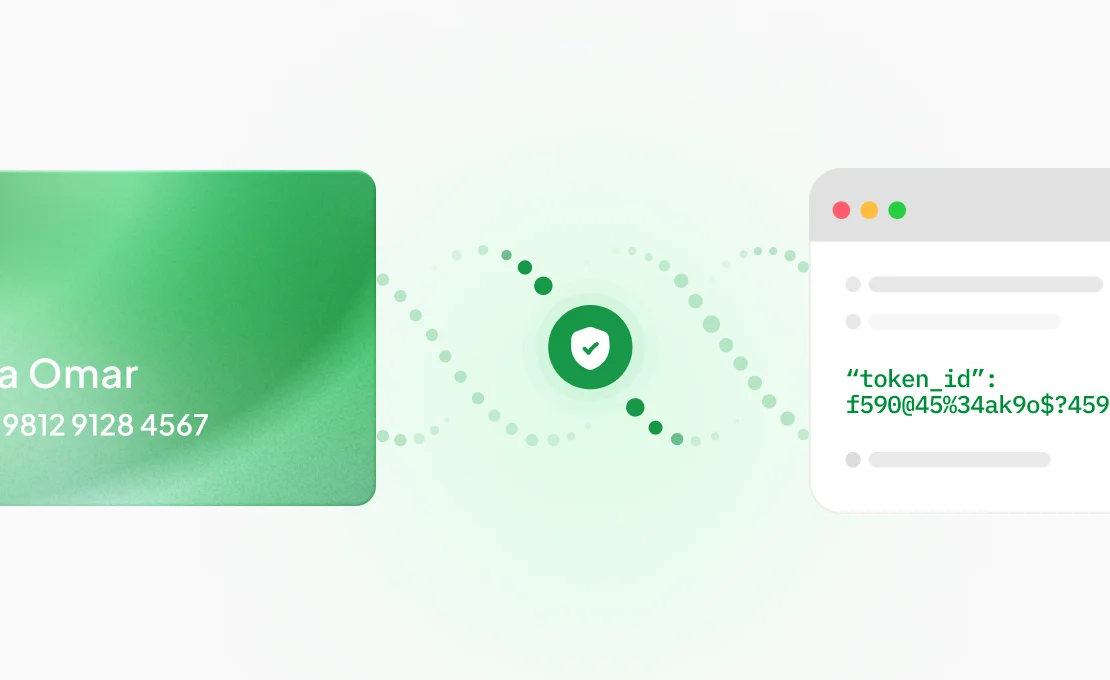
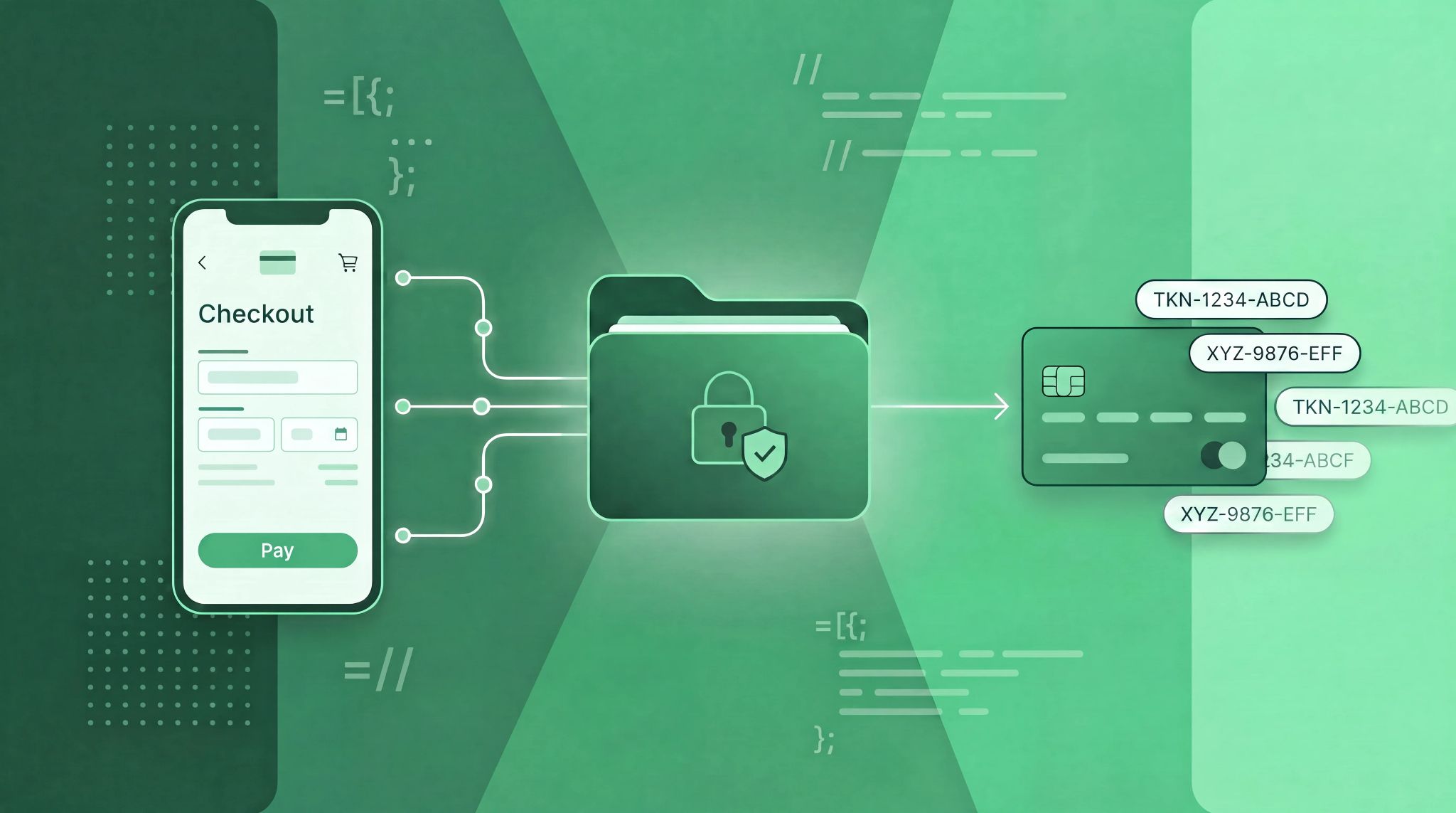
A payment vault, also called a token vault or credit card vault, stores sensitive payment data in tokenized form so the merchant's own systems never hold a usable card number. When a customer pays for the first time, the raw card details go directly into the vault, which returns a token: a random alphanumeric string that represents the card but is meaningless if stolen. From that point on, only the token moves through the merchant's infrastructure.
Payment vault: A secure storage system that replaces a card's Primary Account Number (PAN), expiry, and cardholder name with a token, holds the mapping between the two, and exposes the real credential only under tightly controlled conditions such as settling an authorized payment.
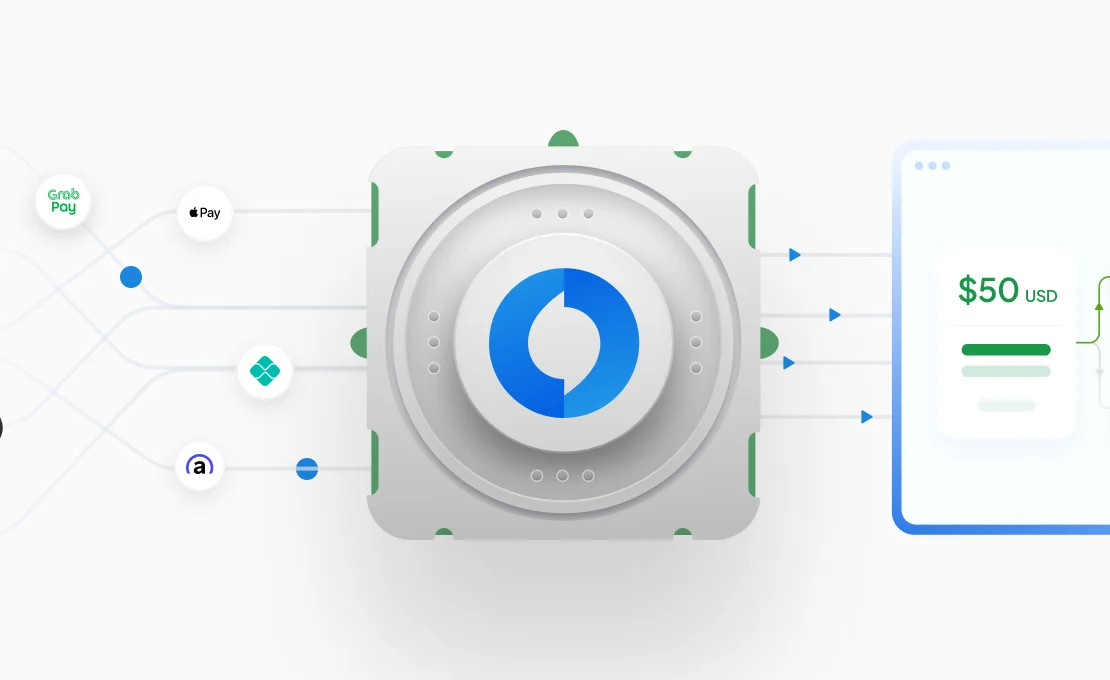
The flow works like this: The customer enters card details at checkout. The vault intercepts that data before it reaches the merchant's servers and issues a token stored against the customer record. For each later charge, the merchant sends the token to a payment processor; the card network exchanges the token for the real PAN at the network level, validates it, and forwards it to the issuing bank for authorization. The issuer's decision flows back through the same chain. At no point does the merchant's environment store, process, or transmit a raw card number.
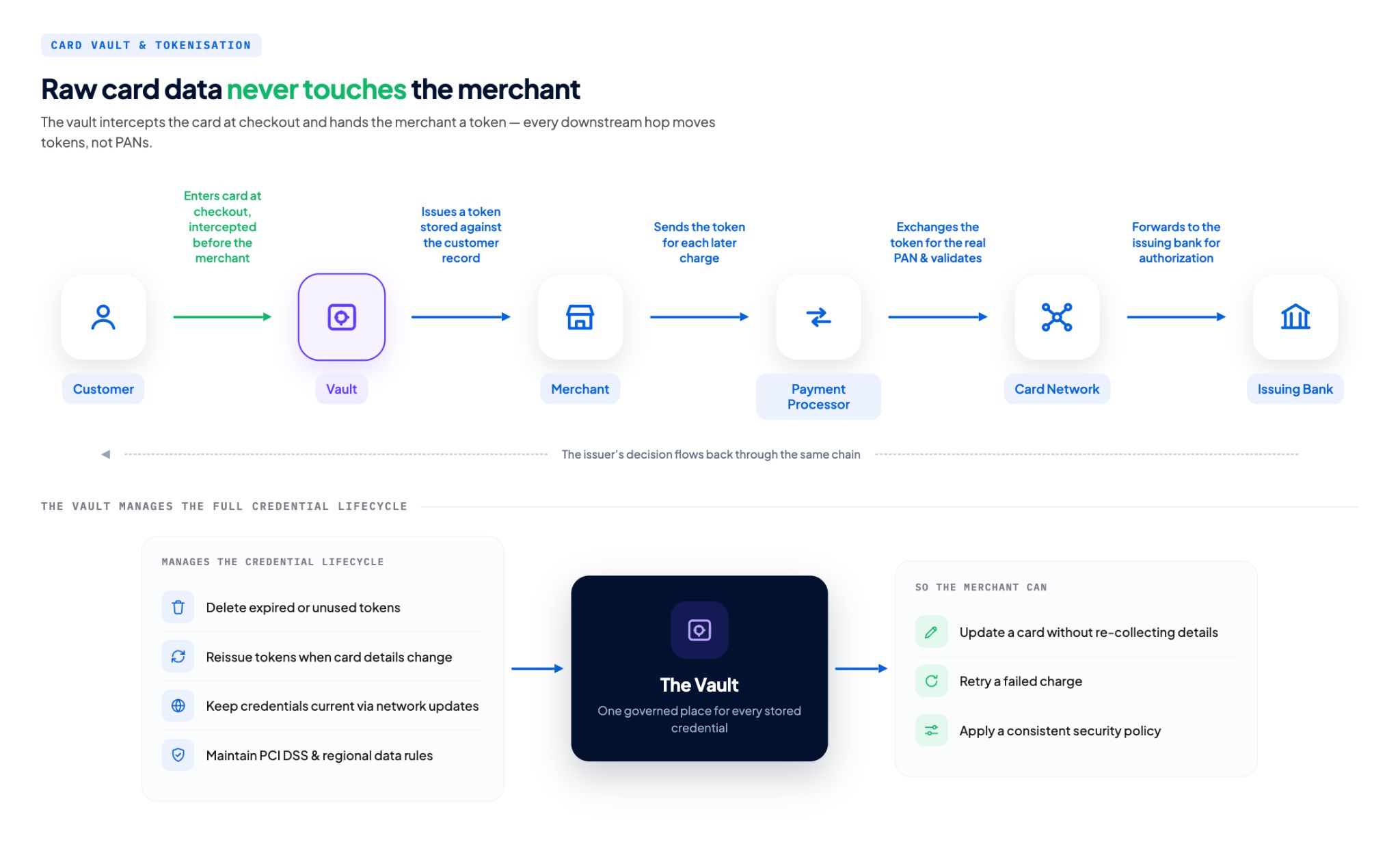
A vault does more than hold data. It manages the full lifecycle of a stored credential: deleting expired or unused tokens, reissuing tokens when card details change, keeping credentials current through network updates, and maintaining compliance with PCI DSS and regional data rules. Storing tokens in one governed place, rather than scattered across systems, is what lets a merchant update a card, retry a failed charge, or apply consistent security policy without re-collecting the customer's details.
Why should merchants use a payment vault? Four business outcomes
Merchants need to use a payment vault to cut breach risk, lift conversion, protect recurring revenue, and reduce PCI compliance cost. All four outcomes trace back to one decision: keeping raw card data out of their own systems. The vault turns stored card numbers, a liability, into portable and reusable tokens without inheriting the security burden.
It reduces breach exposure and its cost. Payment card data is among the most targeted data a business can hold. According to IBM's Cost of a Data Breach Report 2025, the global average breach cost was USD 4.44 million, rising to USD 5.56 million for financial-services organizations and a record USD 10.22 million in the United States. Because a vault ensures the merchant never stores usable card numbers, a compromise of the merchant's own systems yields tokens that are worthless elsewhere, while the underlying credential stays isolated in an audited environment.
It removes a real cause of checkout abandonment. Trust at the payment step directly affects conversion. Baymard Institute's research puts the average documented cart-abandonment rate at roughly 70%, and among shoppers who abandon for fixable reasons, 19% cite not trusting the site with their credit card information. A vault lets merchants offer saved cards and one-click checkout, the frictionless repeat purchase that keeps a customer from re-entering details and reconsidering the purchase.
It protects recurring revenue. For subscriptions and any card-on-file model, a stored, updatable credential is the difference between a renewal that goes through an involuntary churn. Vaults that support network-token lifecycle updates refresh a credential automatically when a card is reissued, lost, or expires, so billing continues without the customer lifting a finger.
It shrinks PCI DSS scope. If a business stores, processes, or transmits cardholder data, it falls under PCI DSS. Routing card capture and storage through a certified vault provider transfers much of the encryption, key management, and audit burden to that provider, which lowers the merchant's compliance scope and, for many, reduces a full audit to a self-assessment questionnaire.
What Sets Payment Vaults Apart
A payment vault is not a payment gateway, and it is different from encryption. A vault stores and tokenizes payment credentials. A gateway sends the transaction to a processor for authorization.
The two work together. The vault holds the secure token; the gateway (or an orchestration layer) moves the transaction along. Because they solve different problems, having a vault does not mean a merchant automatically has a gateway.
When evaluating vaults, keep two more facts in mind.
First, a vault does not give you automatic PCI compliance. It makes compliance easier, but the merchant is still responsible for getting customer consent, sending notifications about stored credentials, and making sure the checkout page collects data securely.
Second, tokenization is not encryption. Encryption scrambles data so it can be unscrambled later with a secret key. Tokenization replaces the data with a random substitute, so a token intercepted in transit cannot be turned back into a real card number. A vault usually uses both, but they do different things. A system that "tokenizes and vaults" data makes a stronger security promise than one that only "encrypts" it.
Where should payment credentials live? A four-option decision framework
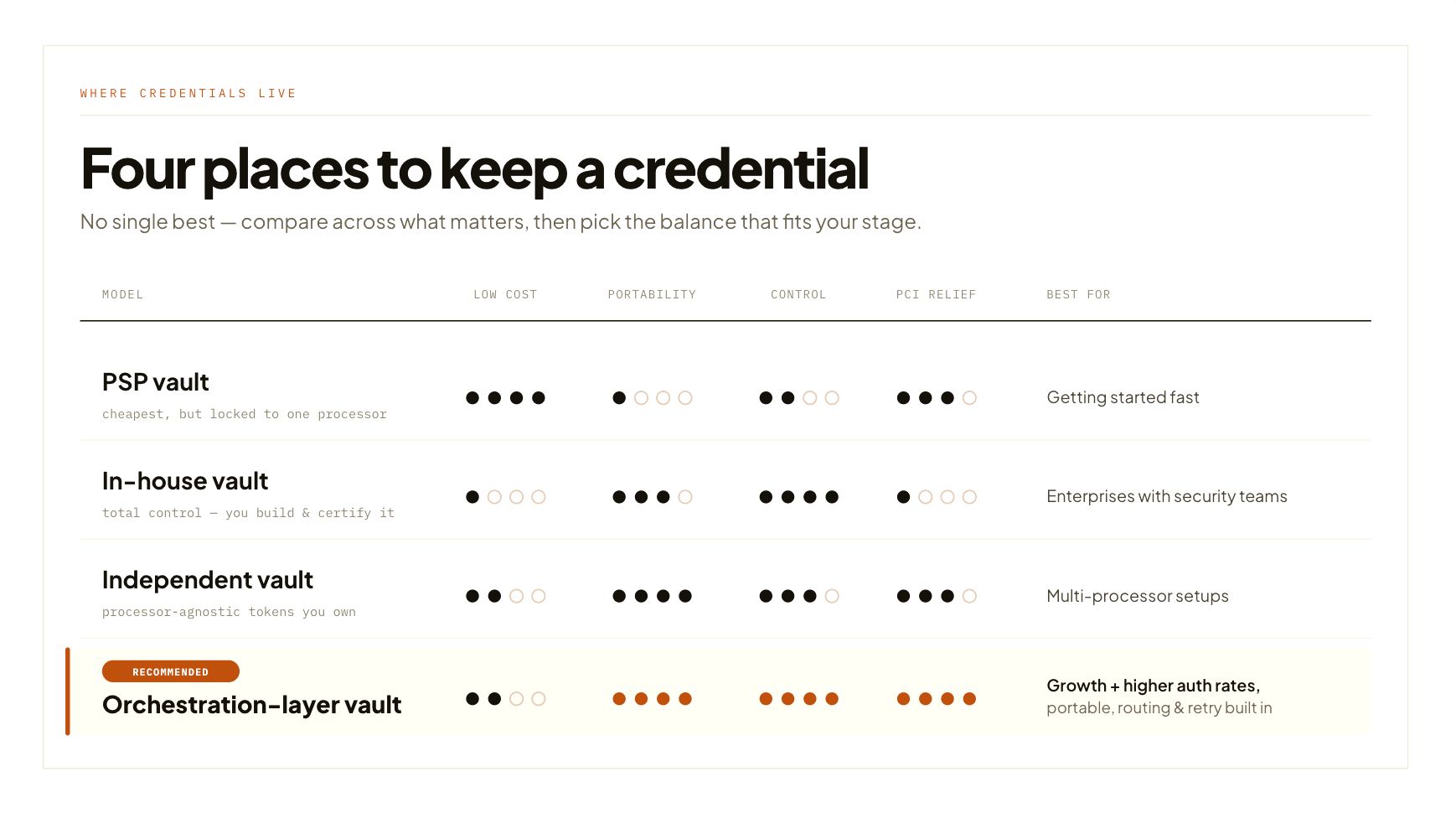
Merchants have four realistic options for storing payment credentials. The best choice depends on the size of the business, its engineering resources, and how much flexibility it needs with a processor. Each option offers a different balance of control, cost, and portability. Therefore, the decision is not about finding a single "best" option, but rather figuring out which factors matter most for your specific business.
The table below compares the four storage models based on the key features that drive this decision. An in-house vault gives you the most control but comes at the highest cost. A PSP vault is the simplest choice but can lock you into one provider. An independent vault gives you portability but adds some complexity. Finally, an orchestration-layer vault tries to combine portability with smart routing.
| Storage model | PCI burden on merchant | Processor portability | Setup & maintenance cost | Best fit |
| In-house vault | Full (PCI DSS Level 1) | Total control | Very high (build, certify, staff) | Large firms with strong security/compliance teams and specific control needs |
| PSP vault | Low | Low (credentials hard to move) | Low (credentials hard to move) | Merchants using a single processor who value simplicity |
| Independent third-party vault | Low | High (processor-agnostic tokens) | Moderate (one extra provider) | Growing merchants who want to add or switch processors freely |
| Orchestration-layer vault | Low | High (tokens plus routing across providers) | Moderate | Merchants who want portability and routing/retry logic in one layer |
The most common regret for businesses involves the PSP vault. Tokenizing exclusively with a single processor is the easiest path at first. However, those tokens are usually tied directly to that processor. If a merchant later wants a second acquirer to get better approval rates in other countries, or if they want to leave the processor entirely, getting the stored credentials back is difficult. Often, the only way out is to request a data export and go through a full re-tokenization process.
To be fair, a merchant that plans to stay with one processor forever loses nothing by choosing a PSP vault. In that case, it remains the cheapest and most reliable option. The vendor lock-in only becomes a problem for businesses whose payment strategy will eventually require more than one provider.
Network tokens raise the value of a vault from a security tool to a revenue tool, because they can lift authorization rates on top of reducing fraud. A network token is issued by the card scheme itself (Visa, Mastercard, and others) rather than by a merchant or processor, is restricted to a specific merchant, and updates automatically when the underlying card changes.
The performance data comes from the schemes themselves. As of its most recent published figures, Visa reports a 4.6% lift in authorization rates on card-not-present transactions for tokenized versus non-tokenized credentials, and roughly a 30% reduction in online fraud versus raw PAN transactions. Mastercard reports an average uplift of about 2.1%, as cited in Solidgate's analysis of scheme data. Visa has issued more than 12.6 billion network tokens since launching the technology in 2014, and Juniper Research projects tokenized transactions will roughly double from 283 billion in 2025 to 574 billion by 2029, as reported by Optimized Payments.
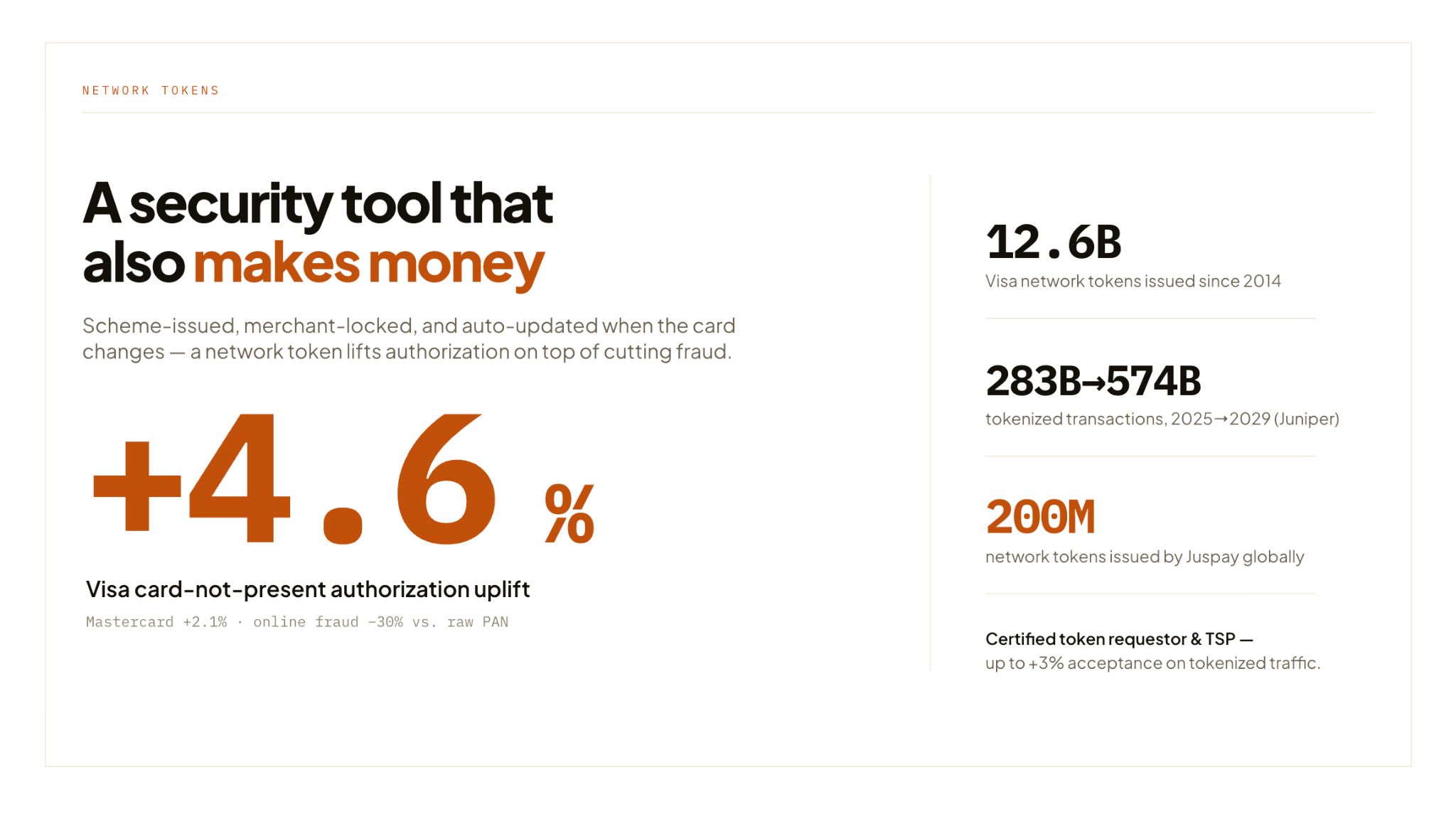
A vault is what makes this usable at scale. Storing a network token, a PSP token, and, where permitted, a clear PAN against the same customer lets a merchant present the credential most likely to be approved for each transaction, and fall back to another format when one fails. Juspay, a certified token requestor and token service provider integrated with major networks, has issued more than 200 million network tokens globally and reports acceptance-rate improvements of up to 3% from network tokenization. The token is only as powerful as the vault's ability to route and retry across formats.
Vaulting beyond cards: wallets, real-time payments, and BNPL
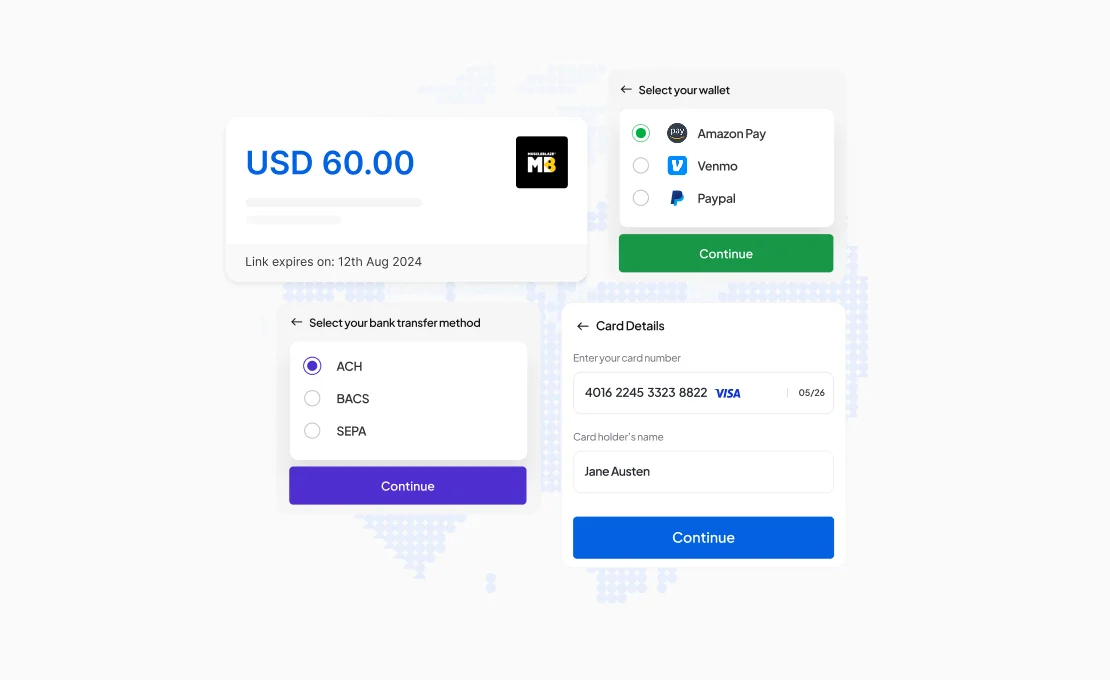
A payment vault is no longer just about cards. In many parts of the world, cards are not the main way people pay. Real-time payment systems, wallets, and buy-now-pay-later credentials all work better with a system where you store details once and reuse them securely. If a vault only stores cards, a business misses out on huge opportunities in the fastest-growing markets.
Looking at the global picture makes this clear. Cards are the most popular choice in the United States and much of Europe. However, real-time account-to-account systems take the lead in countries like India and Brazil, while wallets are the top choice across large parts of Asia and Africa. When a merchant expands into these new regions, they must be able to store and reuse UPI handles, wallet credentials, and BNPL agreements just as easily as they store cards. Otherwise, returning customers will be forced to type in all their details again every time they buy something.
Juspay orchestrates payments across more than 150 countries and handles 300+ million transactions every day. They built their vault to hold tokenized credentials for all of these different payment types. This design was inspired by their experience in the world's busiest market for real-time payments, where relying only on card-on-file logic was never going to be enough.
This is why choosing the right vault is a huge part of a company's expansion strategy. A vault that only works with cards quietly limits a merchant's ability to offer local payment methods. In many parts of the world, having these local methods is the deciding factor in whether a customer actually finishes a purchase.
Where vault implementations commonly fail
Vault projects usually do not fail when they first launch. Instead, they fail months later. These failures tend to follow a few predictable patterns. Understanding these risks early on is the difference between building a vault that acts as a strong core infrastructure and one that becomes a massive migration headache.
The first and most expensive failure is vendor lock-in, which is often discovered when trying to migrate to a new system. For convenience, a merchant might tokenize everything with one PSP. As the business grows, they realize they cannot move those credentials to a second processor without asking every customer to enter their card details again. The fix must happen early in the design process. You should store credentials in a vault that is completely independent of the processor. This ensures your tokens stay portable by design.
The second failure involves single-vault concentration risk. Putting all credentials into one vault improves control. However, it also turns that vault into a single point of failure and a high-value target. The solution is not to split up your storage. Instead, you must choose a vault with strong isolation and audited security. Crucially, it must also have a written and tested path for moving your data out. A vault that you cannot easily leave is a dependency rather than a helpful service.
The Third is coupling tokens to a single processor's format so tightly that adding a new provider means you have to rebuild your entire system. When your routing logic, retry strategy, and token storage are tangled together, bringing on a new acquirer becomes a massive project. To keep future integrations cheap and easy, you need to treat the vault as a clean layer. This means using processor-agnostic tokens and keeping your routing logic completely separate.
The fourth failure is less obvious. It happens when companies treat vaulting simply as a compliance checkbox rather than a tool to boost performance. A vault might successfully reduce your PCI scope. However, if it does not support network tokens, automatic card updates, multi-format retry options, or payment methods beyond cards, you are missing out on major benefits. You leave valuable improvements to your authorization rate and reductions in customer churn on the table. In this scenario, the vault is only doing half of its job.
How Juspay approaches payment vaulting
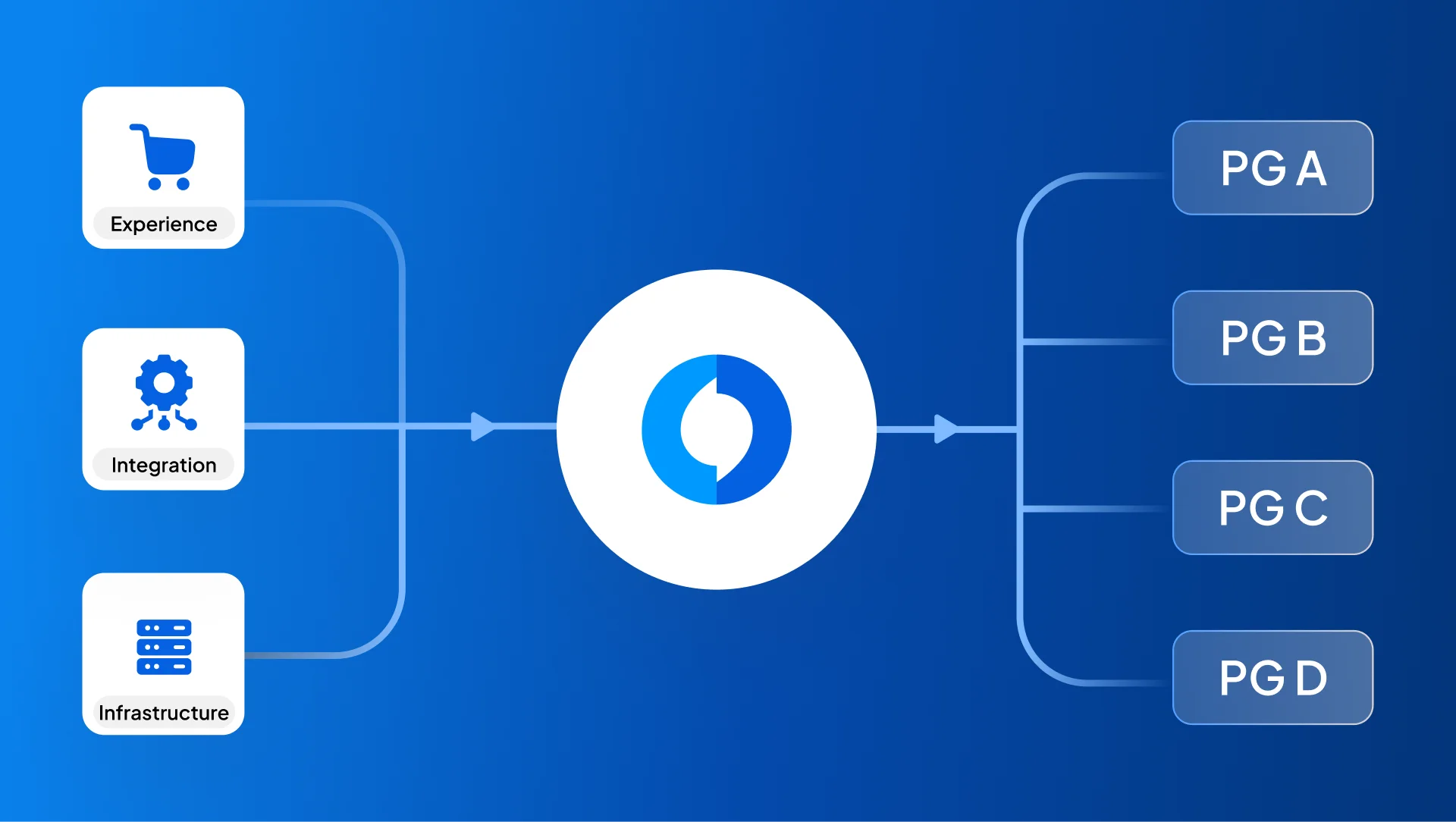
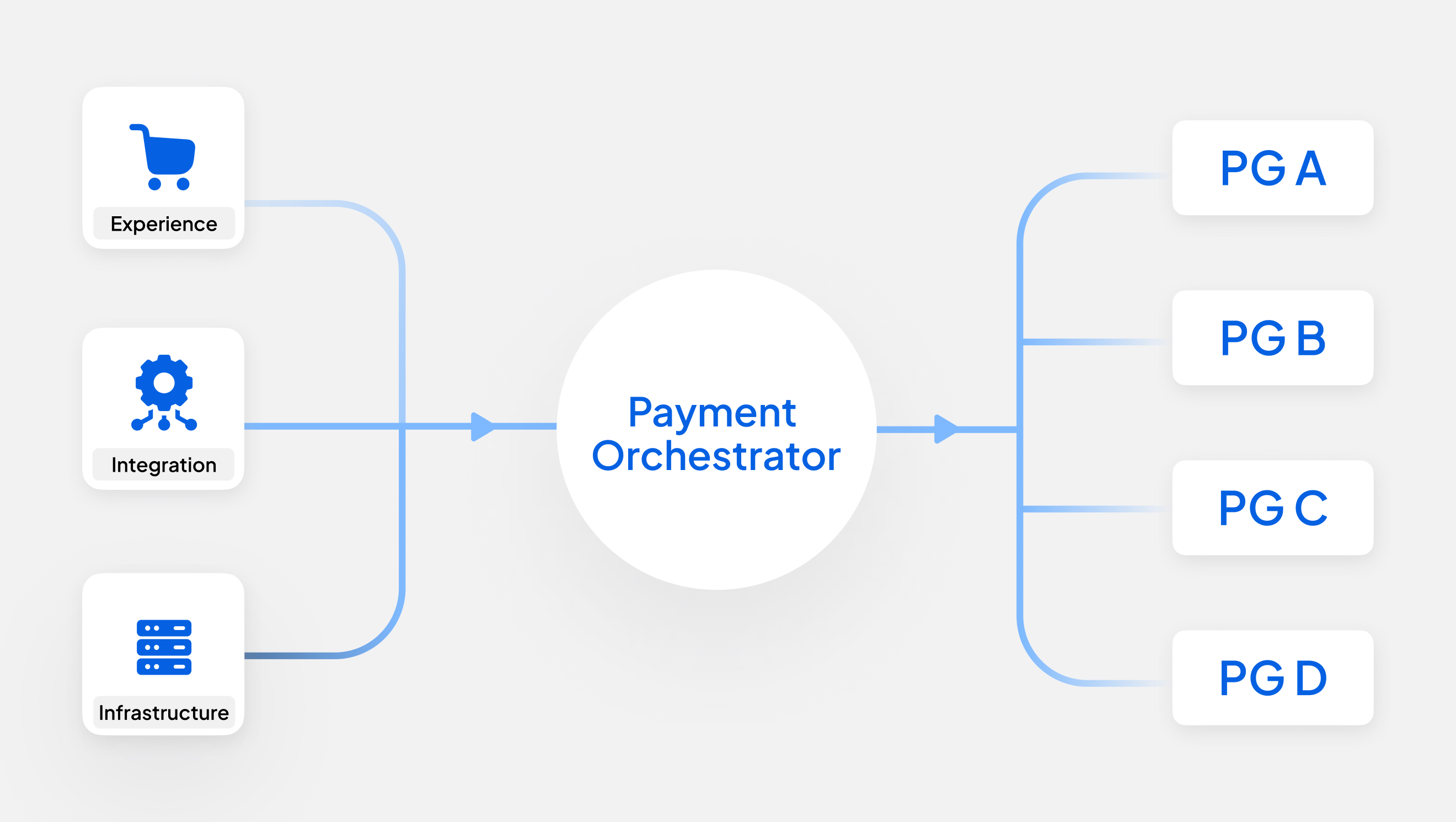
Juspay approaches vaulting as a modular capability inside its orchestration layer. This means merchants can start simple and change their storage model later without having to ask customers for their credentials again. Instead of offering a single, fixed product, Juspay’s vault can be set up in several different ways and can synchronize data across multiple vaults. This design directly solves the problems of vendor lock-in and portability discussed earlier.
Merchants can choose the setup that best fits their compliance needs. They can use an integrated setup that works right out of the box. They can choose a Juspay-hosted vault that shifts PCI responsibility away from their own core team. Alternatively, they can connect to an existing third-party vault they already use. The same orchestration layer supports unified vaulting, PSP-scoped vaulting, and client-scoped vaulting. This allows a platform to give different business units or clients the exact card-data setup they need without building separate systems from scratch.
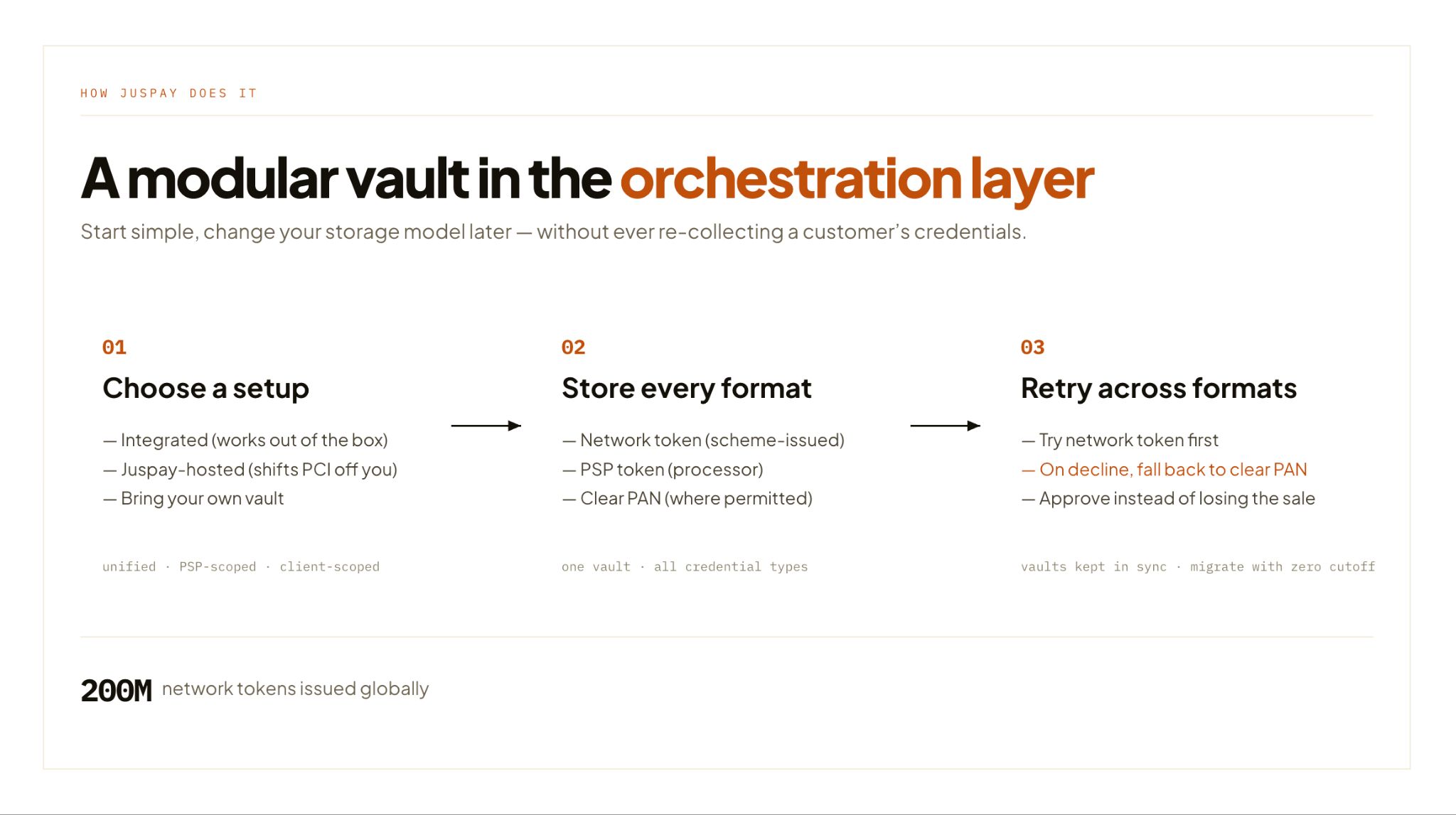
Two specific features make portability much easier. First, Juspay can manage multiple token vaults and keep them perfectly in sync. This allows a business to migrate to a new system smoothly without a sudden cutoff. Second, Juspay’s vault stores multiple token formats. These include network tokens, PSP tokens, and plain card numbers (clear PANs) where permitted. The system then applies smart retry logic across these formats. If a network token fails, it can automatically fall back and try the clear PAN instead of just declining the sale.
When you combine these features with the fact that Juspay has issued over 150 million network tokens globally and supports alternative payment methods beyond cards, it becomes clear that this vault is a powerful performance tool and not just a simple storage bucket.
Key Takeaways
- A payment vault stores card and payment credentials as tokens, so merchants can charge saved payment methods without holding usable card data, which reduces PCI scope and breach exposure.
- The single biggest strategic question is where credentials live: in-house, in a PSP's vault, in an independent third-party vault, or in an orchestration-layer vault. PSP vaults are simplest but create lock-in; independent and orchestration vaults preserve processor portability.
- Vaults do more than secure data. Baymard finds 19% of fixable cart abandonment comes from card-data distrust, and IBM puts the 2025 average breach cost at USD 4.44 million globally. A vault addresses both.
- Network tokens turn a vault into a revenue lever: Visa reports a 4.6% authorization lift on card-not-present transactions and roughly 30% less online fraud; Mastercard reports about 2.1% uplift.
- In most of the world, vaulting cards alone is not enough. Wallets, real-time payments, and BNPL credentials matter as much as cards for merchants expanding across regions.
- Most vault projects fail later, at migration: choose a vault with processor-agnostic tokens and a tested exit path from day one.
Frequently Asked Questions
What is a payment vault and how does it work?
A payment vault is a secure, PCI-compliant system that stores payment credentials as tokens instead of raw card numbers. When a customer pays the first time, their card data goes directly into the vault, which returns a meaningless token. The merchant stores only the token and uses it for every future charge, so its own systems never hold usable card data.
What is the difference between a payment vault and a payment gateway?
A payment vault stores and tokenizes payment credentials; a payment gateway transmits a transaction to a processor for authorization. They are complementary, not interchangeable. The vault holds the reusable token securely, while the gateway moves the actual transaction to a processor. Having a gateway does not give a merchant vaulting, and vice versa.
Does a payment vault reduce PCI DSS compliance scope?
Yes. Routing card capture and storage through a certified vault provider means the merchant no longer stores usable cardholder data, which transfers much of the encryption, key-management, and audit burden to the provider. This substantially reduces PCI DSS scope and, for many merchants, reduces a full audit to a self-assessment questionnaire. It does not eliminate every obligation, such as consent and customer notification.
Should I use my payment processor's vault or an independent one?
Use a processor's vault if you expect to stay on a single processor and value simplicity above all. Choose an independent or orchestration-layer vault if you may add or switch processors, because tokens stored with one PSP are usually bound to it, and moving them later often requires re-collecting cards from every customer. Independent vaults keep credentials portable by design.
How do network tokens improve payment performance?
Network tokens are issued by the card networks, restricted to a specific merchant, and update automatically when a card is reissued. Visa reports a 4.6% authorization-rate lift on card-not-present transactions and about 30% less online fraud versus raw card numbers; Mastercard reports roughly 2.1% uplift. Storing them in a vault lets merchants pick the best-performing credential per transaction and retry across formats.
How does Juspay's payment vault differ from a traditional single-processor vault?
Juspay operates its vault as a modular capability inside an orchestration layer, so merchants can run it self-hosted, Juspay-hosted, or connected to an existing third-party vault, and switch without re-collecting credentials. It stores multiple token formats, applies retry logic across them, orchestrates and syncs across vaults for migration, and covers payment methods well beyond cards.
Can a payment vault store more than credit cards?
Yes. A modern payment vault can tokenize and store wallet credentials, bank and real-time-payment details, and buy-now-pay-later agreements alongside cards. This matters for merchants operating in markets where cards are not dominant. Real-time systems lead in India and Brazil, and wallets lead across much of Asia and Africa, so storing only cards limits which local payment methods a merchant can reliably offer to returning customers.