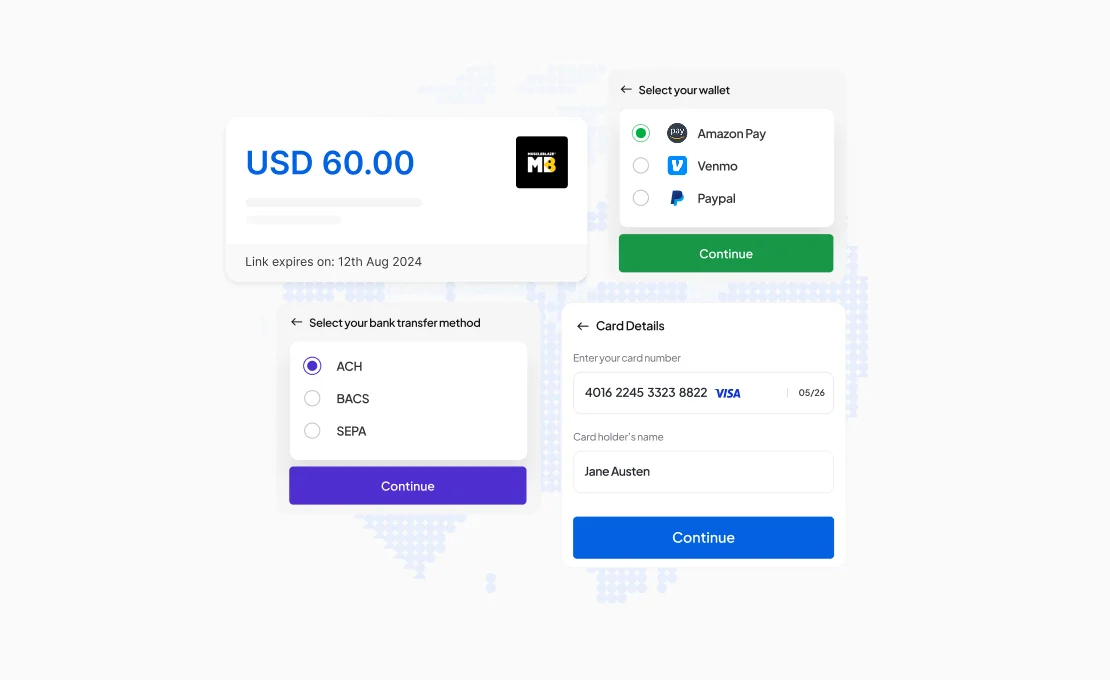










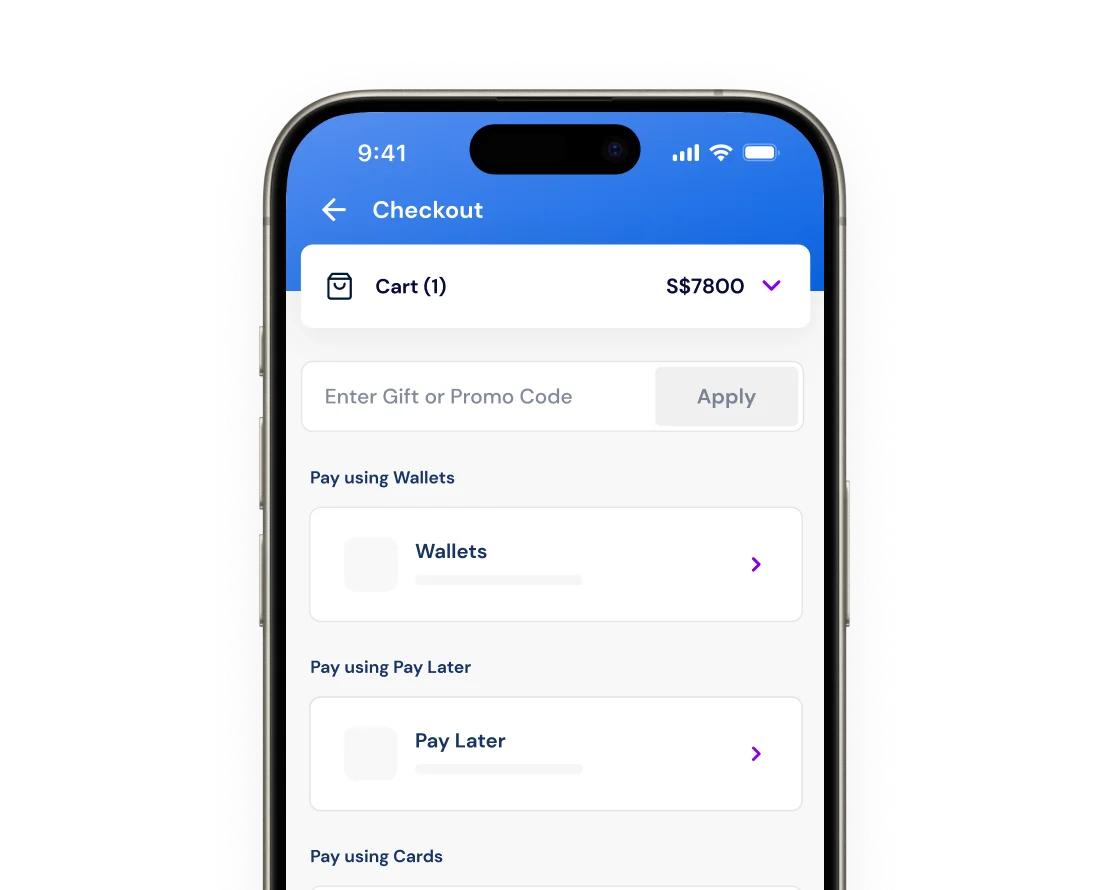



Embedded checkout financing is a type of credit linked directly to a specific purchase. It is offered exactly when you are ready to buy, and the loan is approved in real time for that item, rather than you having to apply for a loan separately beforehand.
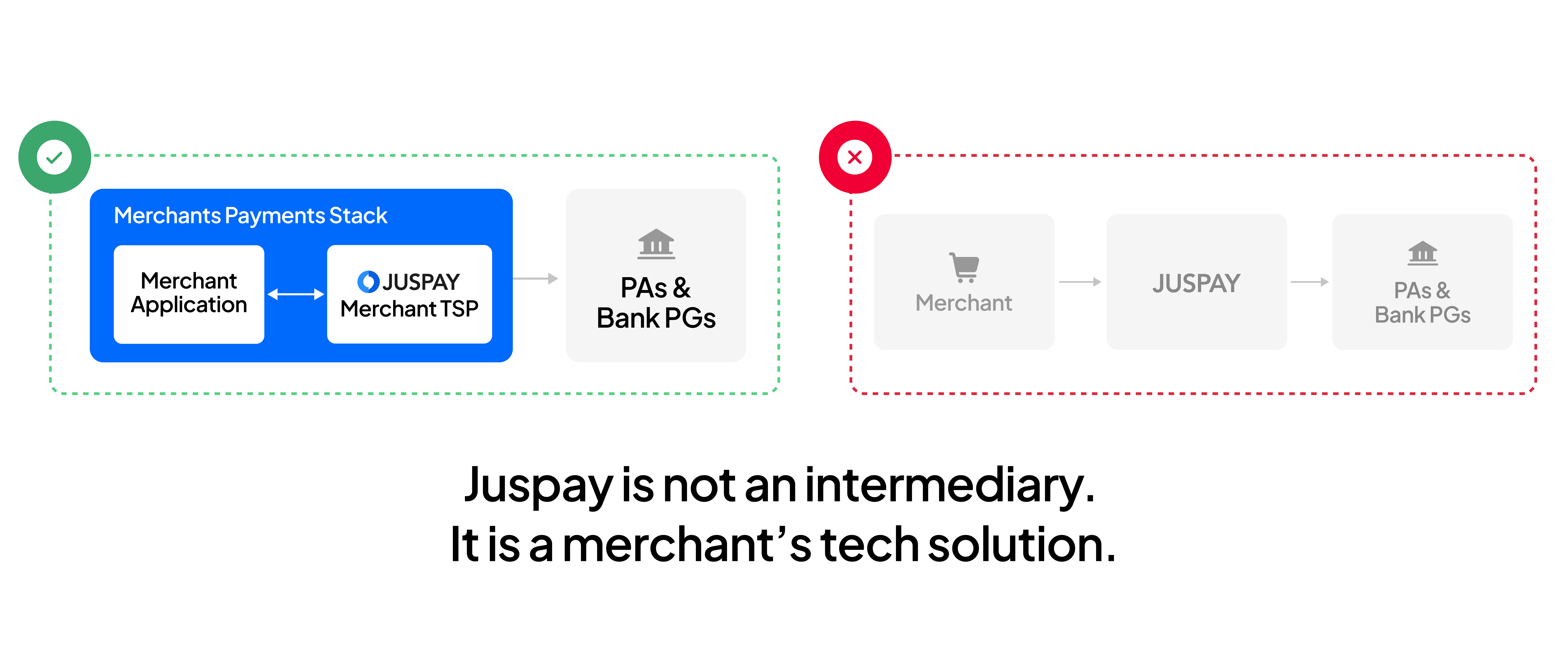
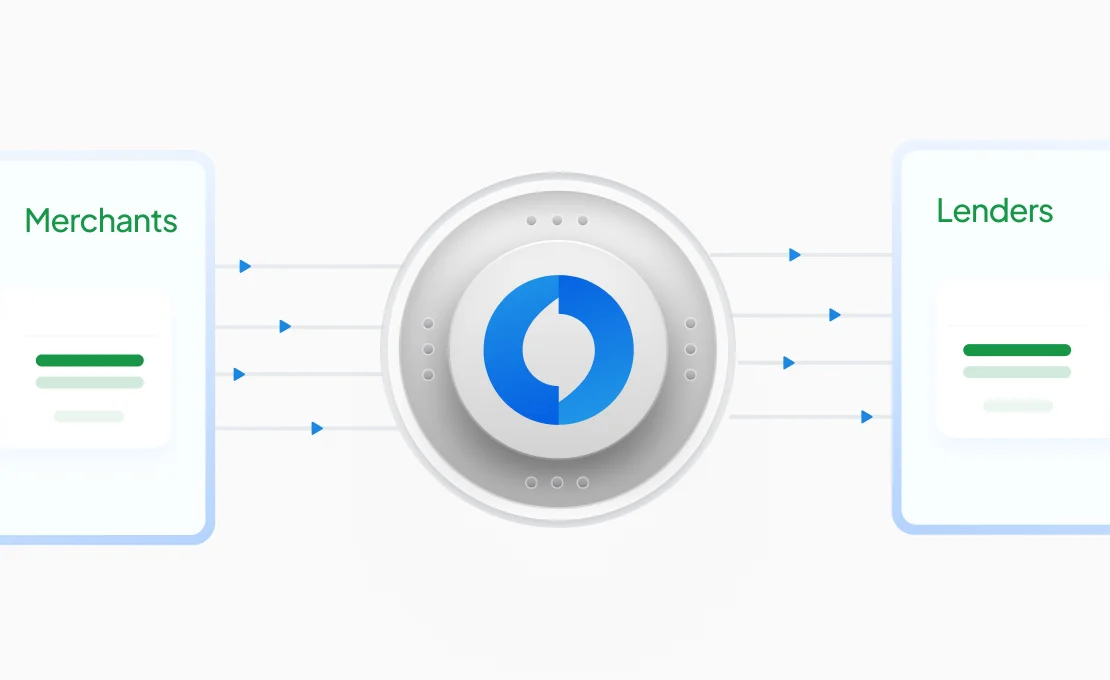
To offer this smoothly to millions of people in India, companies must create a deeply integrated financing experience. It requires complex technical orchestration that connects two distinct layers: the customer-facing journey that the buyer experiences, and the business-facing operations running in the background. Juspay's HyperCredit manages both of these parts together as a single system. This helps merchants succeed when they treat checkout financing like a fully connected operating system, rather than just a simple marketplace of lenders.
If you go through almost any checkout process in India today, you will see equated monthly installment (EMI) options sitting right on the payment page. You will see this whether you are shopping on e-commerce sites, at an offline electronics store, paying an education fee, covering an insurance premium, or making any other large-ticket purchase.
Most of these options are credit card EMIs, which have been a standard part of the payment ecosystem for years. However, checkout financing is a newer and much faster-growing trend where a lender approves your credit instantly at the point of purchase. Even though the user interface looks very simple to the buyer, the technology stack powering a successful financing option is incredibly complex behind the scenes.
Why Is Affordability Now the Default Way India Buys?
67% of all smartphones are sold via financing options in India. The same trends are reflected in the data. Consumer durable loan outstandings has grown at 20% y-o-y in the financial year ending 2026.
The driver is structural, not seasonal. In the current economy, affordability has become the deciding factor in how Indian consumers approach any meaningful purchase.
In short, Affordability is no longer a nice-to-have perk at checkout. For a growing majority of your customers, it is the instrument that drives purchase.
But, there’s a gap in this market worth considering:
The traditional affordability instrument - the credit card has far fewer reach. India has crossed 118 million credit cards in circulation. But there are only 52 million unique card holders. Just 25% of India's roughly 300 million credit-active consumers.
That means the overwhelming majority of your customers who need affordability can't get it from a card. They need financing that lives inside your checkout which approves in real time, against the purchase. That's the opportunity. It's also the place where the complexity begins.
Embedded Checkout Financing vs In-App Personal Loans: Which Converts Better?
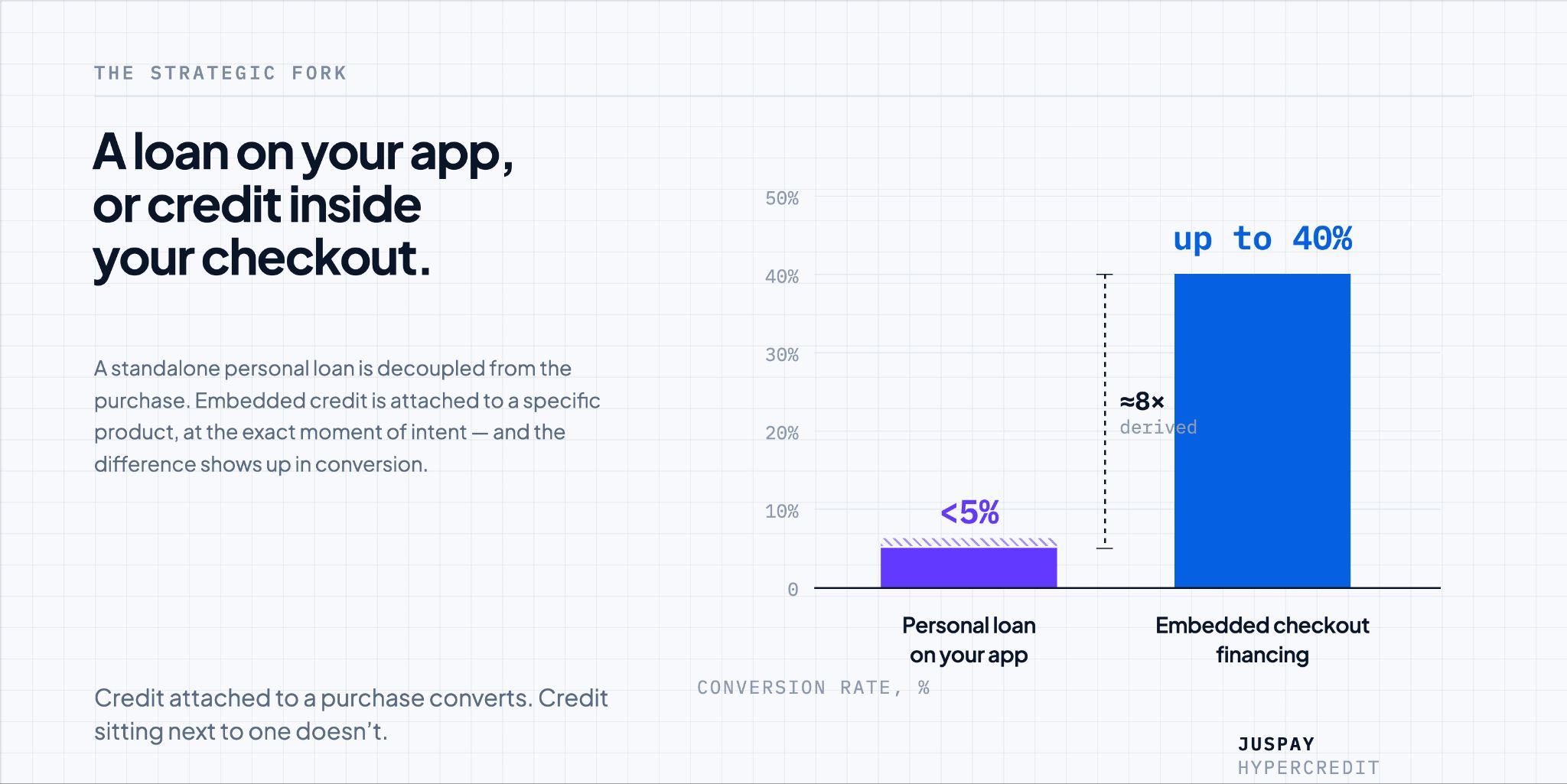
Embedded checkout financing works much better than a standalone personal loan offered inside an app. This is because the credit is linked directly to a specific purchase exactly when you want to buy it, instead of being separate (or decoupled) from the item. Many merchants have tried offering standalone loans by adding a lending partner, a banner, and an embedded loan journey somewhere on their platform. However, this rarely works well. A personal loan that is disconnected from a purchase forces the customer to stop and make a completely separate decision, which often causes them to lose their interest or buying intent. During talks with merchants who offer standalone in-app personal loan products, Juspay has consistently seen that these customer journeys experience conversion rates are typically under 5%.
The other way is embedded checkout finance- the credit is attached to a specific product, offered at the exact moment of purchase intent, scoped to the cart. Conversion on well-built checkout journeys reaches as high as 40%.
The checkout financing is a win for all parties involved. The customer affords the purchase. The merchant converts a sale. The lender grows its portfolio. The strategy is clear. The execution is where it gets challenging and complex.
The table below shows how these two options compare in the areas that affect conversion. Checkout financing is much better at capturing the buyer's intent, while a standalone loan is only better if you want a loan completely independent of your shopping cart.
| Feature | Standalone personal loan in-app | Embedded checkout financing |
| Link to purchase | Separate (decoupled) from any specific product | Attached to the exact product at checkout, unlocks value for the customer. |
| Intent | Happens whenever the customer looks for it | Happens exactly at the moment of buying intent |
| Approval basis | Based on general creditworthiness | Uses a real-time decision against the specific purchase |
| Merchant outcome | No direct cart conversion. | Direct boost to cart conversion and order value |
| Typical friction | Requires a completely separate process and decision | Built naturally into the checkout flow |
Finally, embedded checkout financing is not meant to replace credit card EMI. Instead, it acts as a parallel affordability rail. This means it is an additional option that sits right next to card EMI on the checkout page, helping the much larger group of customers who do not have a usable credit card.
One checkout, four different credit products:
A good checkout financing setup needs several different credit products. This is because the best option changes depending on the ticket size (the cost of the item), the type of product, and the customer. If you treat checkout financing as just one single product, you force every transaction into the exact same process, which usually does not work well for most of them. What a customer needs when spending ₹1,200 is very different from what they need for a ₹50,000 purchase or a two-year education course.For ticket size of:
- Below ₹1,500: The customer needs a simple pay-later product. The process should be very quick, with a fast first-time setup (known as onboarding) and future purchases taking just seconds to complete.
- ₹3,000 to ₹10,000: A basic three-month plan usually works best to get people to finish their purchase (or convert), especially when it comes at zero extra cost to the customer.
- ₹15,000 to ₹50,000: Customers need EMI options (monthly payment plans) spread over 3, 6, 9, or 12 months. These are often supported by coupons, no-cost EMI, and special discounts funded by the brands.
- A high-ticket purchase, or an upskilling course on an edtech platform: These large purchases need loan lengths (or tenures) that can stretch up to 48 months. Customers also need the flexibility to make a down payment and only finance the remaining balance.
Your offering needs to cover the border use case. Not just offer checkout finance. It requires to read ticket size, category, customer - and maps each transaction to the right product, right lender, right tenure, and right journey depth in real time.
Why do you need orchestration?
Approval rates differ sharply based on demography, pin code, and product category. For instance, a lender with excellent metro approval rates might decline many applications in Tier 3 pin codes. Similarly, a lender that is strong in electronics might underperform in the education category. Because of this, there is no universal "best lender." There is only the best lender for a specific customer, location, and purchase.
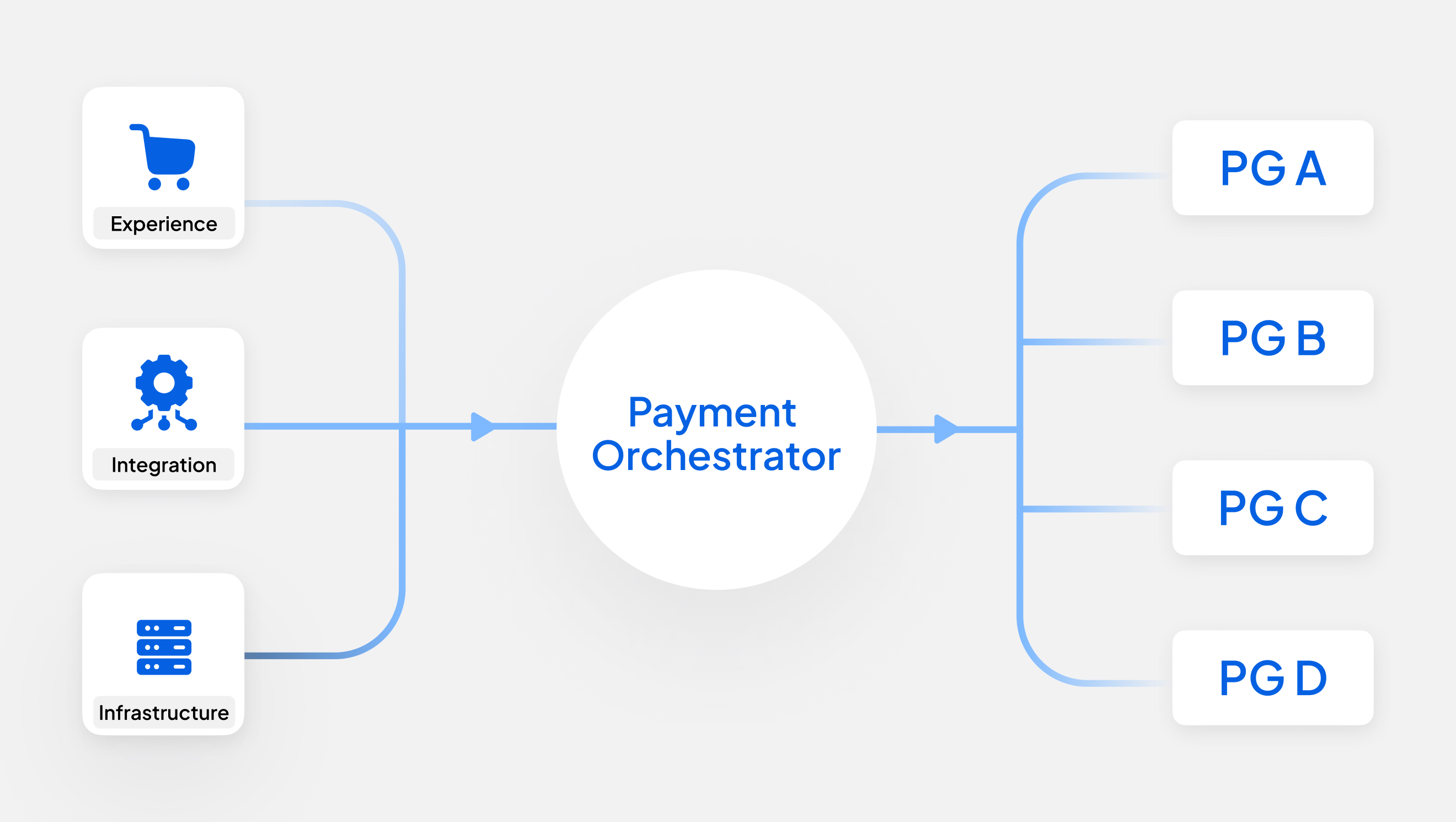
An orchestration engine solves this by identifying who the customer is before the checkout journey even starts. It checks whether the buyer is existing-to-bank or new-to-bank, and if they are pre-qualified or not. After checking these details, it dynamically routes the customer to the lender with the highest approval chances based on their unique profile, pin code, and category.
The two orchestrations behind every checkout financing flow
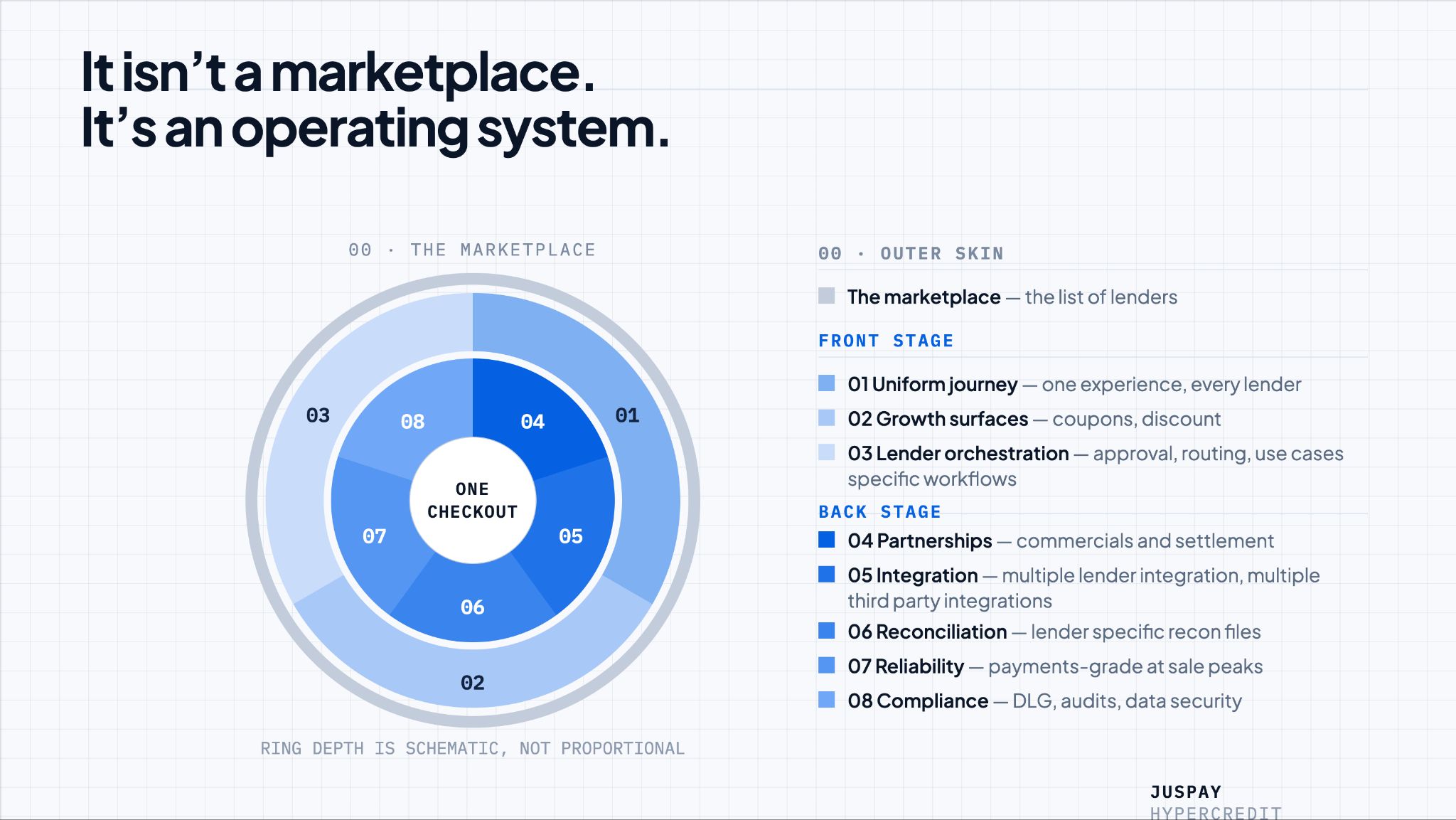
Every checkout financing product runs two processes, or orchestrations, at the same time. First, there is the front-stage orchestration, which includes everything the customer sees and experiences. Second, there is the back-stage orchestration, which involves everything the business and its operations must handle.
Most merchants underestimate how important this second part is. A marketplace of lenders is just the visible layer that people see. However, these two orchestrations act as the underlying operating system that actually makes the marketplace work properly.Let's walk through both.
Front stage: what your customer experiences?
- Your customer needs a uniform journey across lenders.
Your customer needs an experience which is uniform across lenders. Every lender-specific quirk that leaks into the experience costs you trust - and trust at checkout converts directly into drop-off.
- A system built to drive growth.
A good checkout financing is an option that does more than offering affordable financing. It helps you drive your customers from the front. It needs to interact with customers at multiple touch points.
| Interface | Feature | Impact |
| Product Page | Display affordability/EMI options at the product detail page, check customer’s eligibility | Shapes purchase decisions early; makes affordability the primary option |
| EMI plan discovery | Help your customer discover Brand EMI, no-cost EMI, and Discount offers | Surface relevant EMI offers for each customer’s specific purchase |
| EMI offer Selection | Flexibility to choose downpayment and apply for EMI for the remaining | Convert purchases which can’t be fully financed |
| Checkout | Surfaces personalized offers using purpose-built, category-specific flows. For example, a flight ticket purchase would require user-specific journey sizing based on the ticket size, along with specialized retargeting | Improves conversion, ensures discovery of correct financing option, reduce friction and cart abandonment |
| Conversion / Fallbacks | Fallbacks at every stage are required among different providers (KYC, mandate, etc.) | Prevents abandonment; enables resuming journeys without restarting |
- You need orchestration that gets the customer approved
Having five lenders on your checkout does not make it efficient if the customer is not routed through the lender with highest chances of approval, personalized as per each customer.
Back stage: what does your business absorb?
There are back stage challenges that each business absorbs. There Operations nobody prices in and technical challenges that nobody saw coming.
- Every lender is its own business partnership and process alignment.
Before a single affordability leads flows to a lender, your partnership team has to iron out the commercial agreement with each lender, the EMI offers, the subvention structures, the user flow and the settlement terms. Repeat it again with each lender. Each of such cycles spans into a month's long window. You need a process or a partner who does not slow you down. Your business focuses on growth, not aligning lending partnerships.
- GTM for each lender is a custom integration
Taking lenders live one by one involves separate tech builds, testing, and go-live phases. This step-by-step process makes your go-to-market (GTM) cycle painfully slow. Most importantly, each lender requires its own unique set of technical integrations.
To help your business move faster, your product needs to modularize each integration. You need a pre-built adapter model where you only perform one main integration. Behind that single integration, new lenders can be easily added, swapped, or scaled. As a result, the go-to-market time for each new lender drops from several months to just a few weeks.
- Every lender reconciliation needs alignment with your accounting
Each lender ships its own reconciliation format; your finance system expects one. Without a normalization layer, your back-office workload multiplies with every lender you add. You need a system to work with one, reconciliation, settlement, and reporting, and does not change - no matter how many lenders sit behind the curtain.
- A payment grade reliability is required for sale-day scale
Checkout financing does not sit in a separate step. It is built directly into your main payment flow. Because of this, it must have payments-grade reliability.
Data has to flow accurately across every journey, every time. And the system has to hold at scale on the days it matters most: sale events, when traffic spikes to population-scale peaks and every request is a customer mid-purchase. In this flow, a failed affordability attempt is a lost customer.
- Compliance should be in-built within the system.
Digital lending regulation in India is constantly changing. For example, DLG norms shift frequently. As a result, every lender you work with will enforce its own audit requirements on you as the LSP.
Meeting these high standards means compliance must be built as a core part of your system. Your data must be securely stored with encryption and structured according to regulatory rules. You also need a clear data purging policy and strict rules for handling personal information safely. Finally, you must always ensure that you are providing financing options in a transparent and fair manner.
The real moat is the operating system, not the lender list
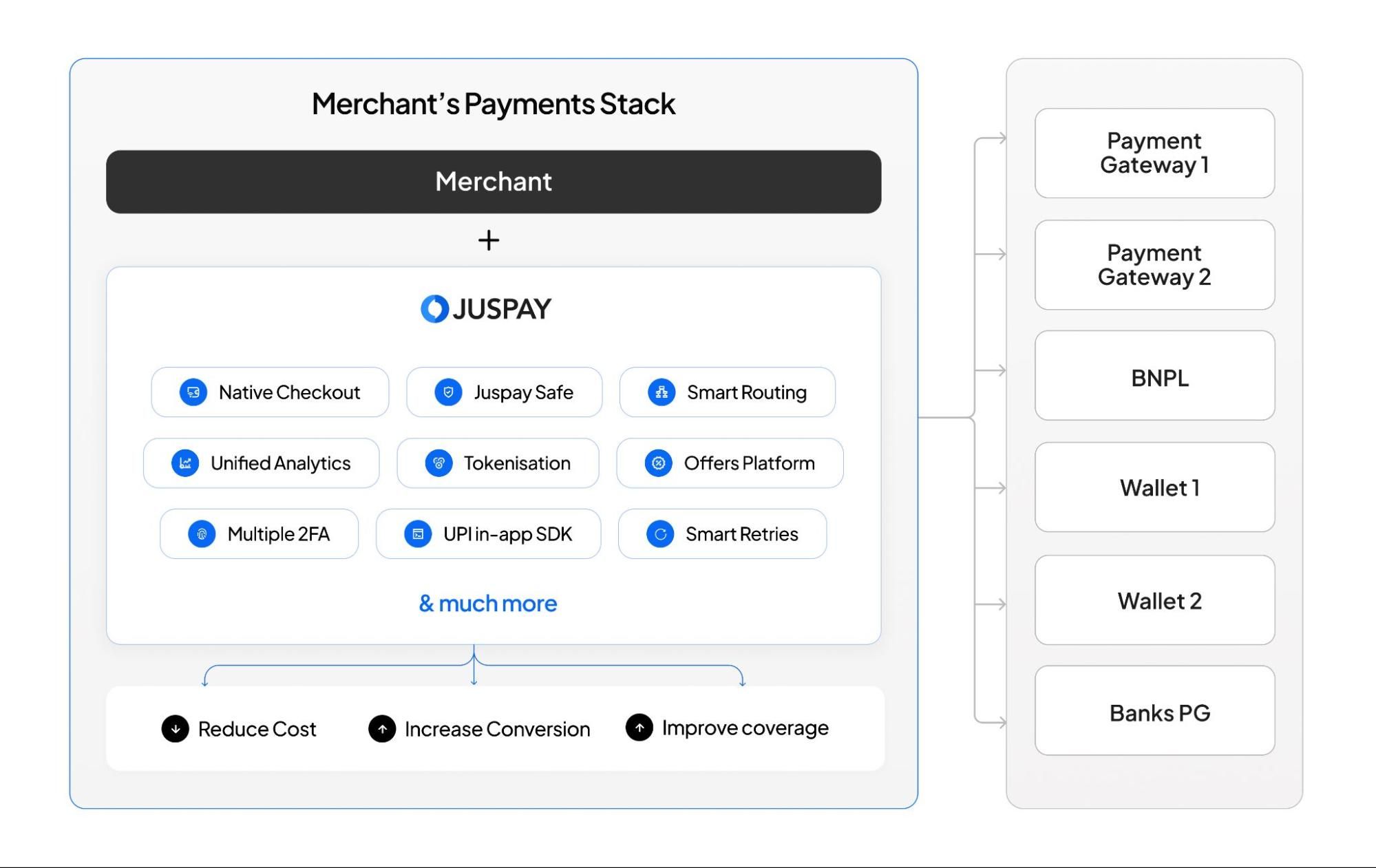
The differentiator in checkout financing is the operating system running behind the Buy button, rather than just the visible list of lenders. Think about what it takes to offer this successfully at a massive scale. You need the exact right credit product for every ticket size and customer segment. You must create a smooth and uniform journey no matter which lender is chosen.
The system needs smart routing that looks at the user's demography, pin code, and product category. For the business, it means having just one commercial relationship instead of doing ten different negotiations. It requires only one technical integration instead of ten separate builds. You also need a single reconciliation format for your accounting instead of managing ten different spreadsheets. Furthermore, the system must have payments-grade reliability to handle massive traffic at a sale-event scale. Finally, it must have compliance measures that update automatically as fast as government regulation changes. The actual marketplace of lenders is just a very thin layer sitting on top of all this heavy background work.
Juspay built HyperCredit to act as this complete operating system. It serves as a single partner that handles all the complex work happening below the Buy button. This allows the merchant to focus completely on their store and the customer experience above it.
This approach has proven very successful in the real world. For example, Juspay's HyperCredit stack now powers Flipkart's EMI programme. It matches customers to the most suitable lenders in real time.This integration resulted in roughly a 2X increase in new users choosing to use EMI.
Similarly, Amity University Online used this exact same engine to fix their fragmented, multi-portal loan process. By aggregating lenders under just one single entry point, they were able to combine all payment confirmations, lender statuses, and final reconciliation data into one easy-to-manage view.
Key Takeaways
- Affordability has become the default way India buys. Financing now backs about 67% of smartphone sales. Additionally, consumer durable loans are growing at 20% year-over-year, which is faster than personal loans. Despite this high demand, credit cards reach only about 52 million unique cardholders.
- A standalone personal loan offered inside a merchant app converts at under 5%. On the other hand, embedded checkout financing converts at up to 40%. This higher success rate happens because the financing is attached directly to the purchase exactly at the customer's moment of intent.
- Affordability covers multiple products. These products include Pay Later, zero-cost short EMIs, standard EMIs, and long-tenure financing of up to 48 months. The customer journeys must vary by segment. This variation is necessary because KYC and mandate requirements differ based on the ticket size and the product category.
- Checkout financing demands two types of orchestration at the same time. First, it requires front-stage orchestration. This includes uniform journeys, conversion-focused lending flows, and demography-aware routing. Second, it requires back-stage orchestration to handle lender agreements, integrations, reconciliation, scale engineering, and compliance.
- The true defensible advantage is not just having a long lender list. Instead, the real advantage is the operating system underneath it all. This system successfully runs both the front-stage and back-stage orchestrations in real time.
Frequently Asked Questions
What is embedded checkout financing?
Embedded checkout financing is a type of credit offered right inside a merchant's checkout page. It is attached to the exact item you are buying and gets approved in real time against that specific transaction, rather than needing to apply for a loan separately beforehand. It includes options like pay-later, no-cost EMI, standard EMI, and loans with longer payment terms. This setup helps reach customers who cannot get these affordability options using a regular credit card.
How is checkout financing different from a credit card EMI?
Checkout financing is a credit product provided by a lender that gets approved exactly at the point of purchase. On the other hand, a credit card EMI simply turns a purchase you already made with your card into monthly installments. This means card EMI only works if the customer already has a credit card. Because only about 25% of individual borrowers in India actually have credit cards, checkout financing is able to reach a much larger group of buyers.
Why does checkout financing convert better than a personal loan inside an app?
It converts better because the credit is tied directly to a specific product exactly when the customer has the buying intent. A standalone personal loan is separate or decoupled from any purchase, which forces the customer to stop and make a completely separate decision. Industry research on embedded point-of-sale financing shows that when financing options are shown early in the shopping process, businesses see conversion lifts up to 40%.
What is lender orchestration in checkout financing?
Lender orchestration is a smart system that routes each customer to the lender most likely to approve them. It does this by looking at the customer's profile, pin code, and product category, instead of just showing every lender equally. Approval rates change a lot based on a person's background and what they are buying. Because of this, using a multi-lender waterfall system that routes dynamically can make approval rates much higher.
What does it take to offer checkout financing at scale in India?
Offering this at a massive scale requires having several different credit products that match different ticket sizes. It also needs a smooth and uniform customer journey across all lenders, real-time approval routing, and just one commercial and technical integration instead of many. Furthermore, it needs a normalised reconciliation format for accounting, payments-grade reliability to handle huge traffic spikes during major sale events, and built-in compliance to handle changing RBI and DLG norms. The visible lender marketplace is just a thin layer sitting on top of all this complex background work.
How does Juspay's HyperCredit support embedded checkout financing?
Juspay's HyperCredit is a complete checkout financing and loan operations system. It handles both the front-stage customer journey and the back-stage operations through just one single integration. It offers multi-lender routing, customized journeys for different ticket sizes, safe fallbacks in case a step fails, and a normalised reconciliation process. For example, HyperCredit powers Flipkart's EMI programme.This integration led to roughly a 2X increase in new users choosing the EMI option.