













Most airlines manage promotions through their Passenger Service System (PSS), the same system used for reservations and fares. Over time, it has also become the default place for applying discounts. Marketing teams decide the budget and promotion rules, how much to offer, on which fares, and how much they expect to spend.
The limitation comes when that discount is applied. The PSS follows predefined rules: if the criteria match, the discount is triggered. It has no context on whether the traveler was already likely to book or was close to abandoning the purchase. As a result, a traveler who was always going to book and one about to abandon receive the same discount, and the budget is spent regardless of whether the incentive actually influenced the booking.
Market Complexities
This challenge looks different across markets, where customer expectations and promotional strategies vary significantly. In the Middle East, Southeast Asia, Latin America and India, travelers often expect payment-linked offers at checkout. These might include discounts tied to a particular card issuer or interest-free installments on higher-value fares, where spreading the cost can help convert the booking.
In the US and Europe, promotions tend to lean more heavily on loyalty, with co-branded cards, points and miles playing a greater role in influencing purchase decisions.
The complexity is that card offers, installments, loyalty redemptions and fare promotions are typically managed through separate systems, each with its own rules and reporting. For airlines running several of these programmes simultaneously, that creates fragmented decision-making and makes it difficult to understand the true cost of a campaign or which incentive actually drove the booking.
The reservation system was built for fares, not tailored Promotions.
The PSS was designed to price journeys based on the passenger, itinerary and fare class. That works well for managing fares, but it is less suited to the way modern promotions need to operate. Today, promo codes are typically applied at a passenger or journey level rather than treating the booking as a single order.
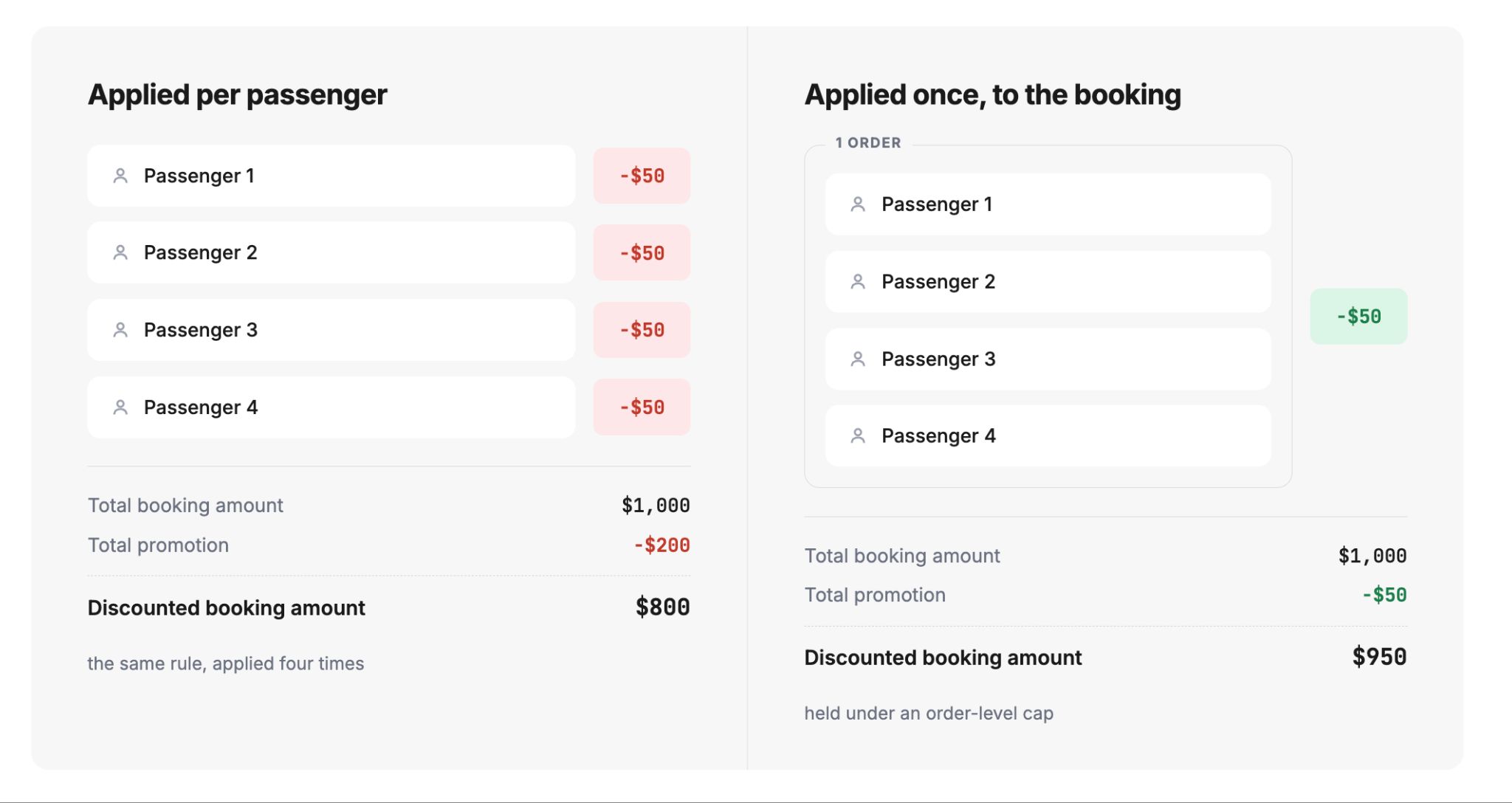
This becomes a problem with something as simple as a fixed discount. A specific discount amount may be applied per passenger and, depending on how the fare is structured, repeated across multiple legs rather than deducted once from the total booking.
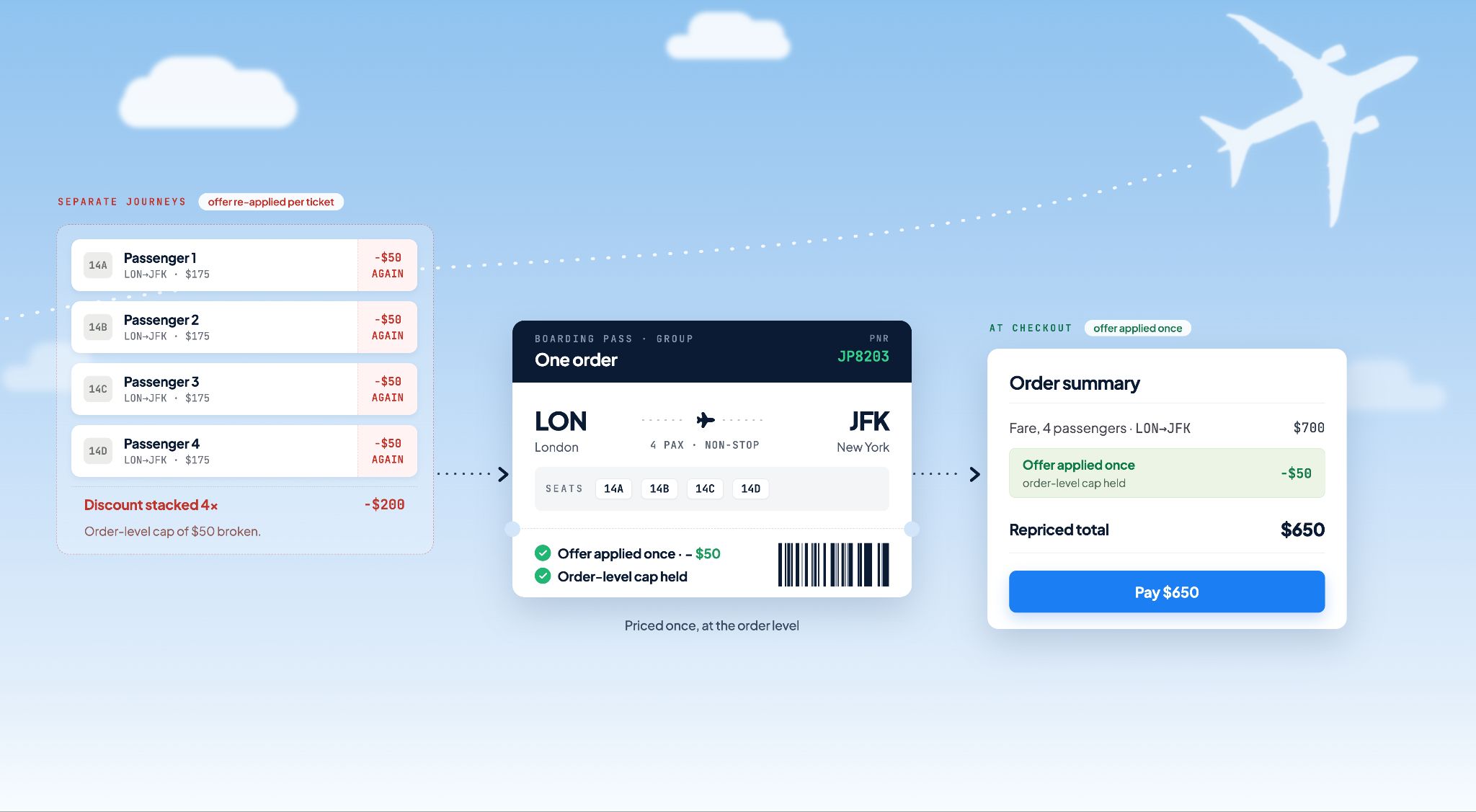
For a single passenger flying one way, the calculation works. For a family of four on a return journey, however, the discount can multiply across passengers and legs, meaning the airline gives away significantly more than intended. Without an order-level cap, there is no reliable limit on the total discount applied.
Individual bookings may not look unusual, making the leakage difficult to spot. But across multiple campaigns at a high-volume airline, small amounts of unintended discount can quickly become significant. With airline margins already extremely tight, promotions need much tighter control over how and where every discount is applied. IATA forecasts a net margin of around 2.0% across the industry in 2026, with net profit of roughly $4.50 per passenger carried, half what airlines managed the year before. At that level, a discount that scaled further than anyone intended is consequential.
The industry itself is moving towards an order-centric model. IATA’s Offers and Orders programme is designed to move airlines away from legacy tickets, fare rules and ancillary documents towards a more modern retailing model built around offers and a single order. The deadline set by IATA is 2030 but progress has been slow. A white paper from Atmosphere Research Group and Accelya found only 27% of airlines have taken substantive steps toward it, and NDC, the standard the whole shift depends on, still hasn't reached universal adoption thirteen years after launch.
That shift matters for promotions too. When the booking is treated as a complete order rather than a collection of passengers, fares and individual transactions, airlines have a much stronger foundation for deciding how an offer should be applied and controlling its value across the entire booking.
What changes when Promotions run at the order level
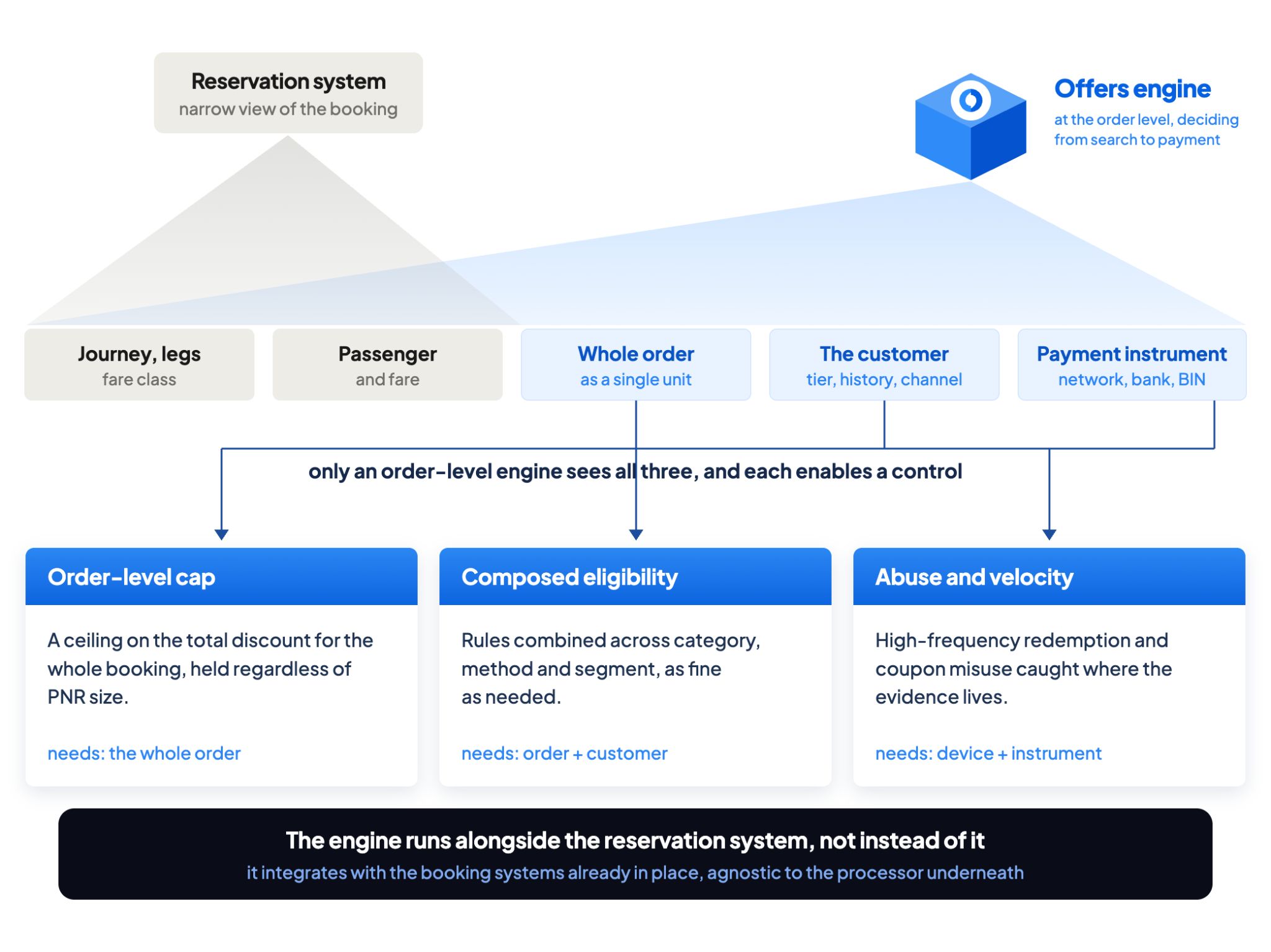
An order-level promotions engine sees the booking as a whole: the itinerary, the customer and, once they reach checkout, how they intend to pay. That creates opportunities that are difficult to achieve when promotions are tied only to fares or individual passengers.
One discount per booking, not per passenger
When a discount is calculated against the entire order, a fixed amount stays fixed. It does not multiply across passengers or different legs of the journey. For the family booking above, the engine sees one order and applies one discount, with a clear cap on the total amount the airline is willing to give away.
Promotions can use customer and payment data
A fare record primarily understands the journey and fare class. An order-level engine can bring in much richer context, including the customer, their booking history and the payment method selected at checkout. Promotions can therefore be based on more than where someone is flying or the fare they have chosen, giving airlines greater control over who receives an offer and when.
Coupon misuse and velocity controls
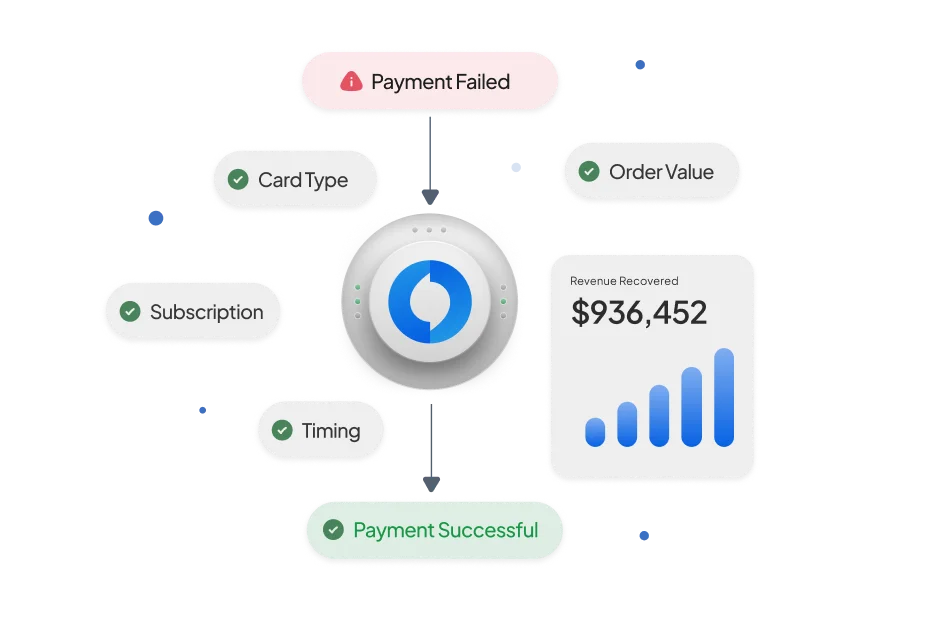
Catching high-frequency redemption and coupon misuse depends on signals like device, payment instrument, and behavioral patterns. None of them reach the reservation record. They belong to the order, so an order-level engine can act on them as it grants the discount, instead of the problem showing up in a reconciliation report weeks later.
How Juspay's Promos & Offers engine handles this
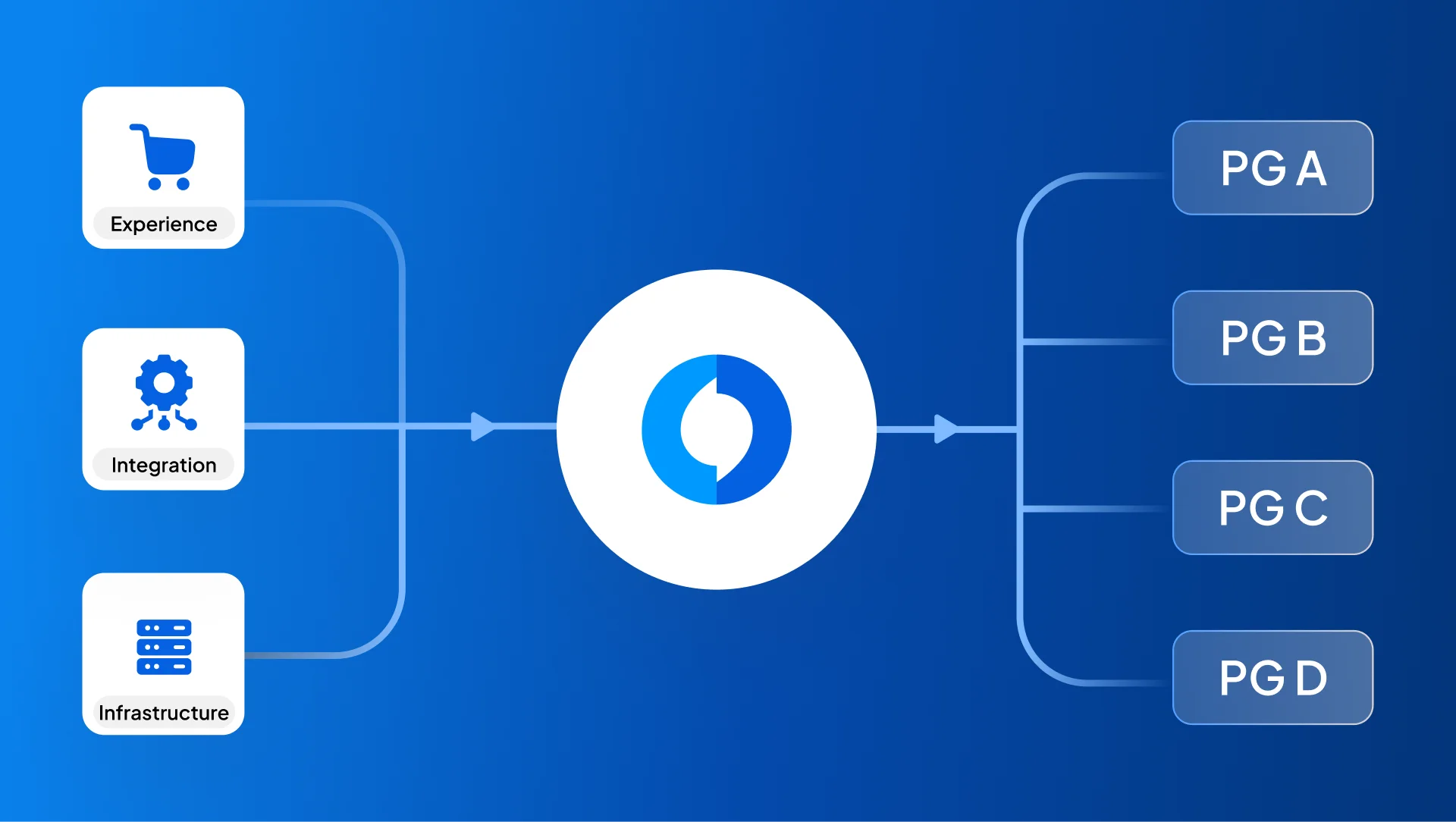
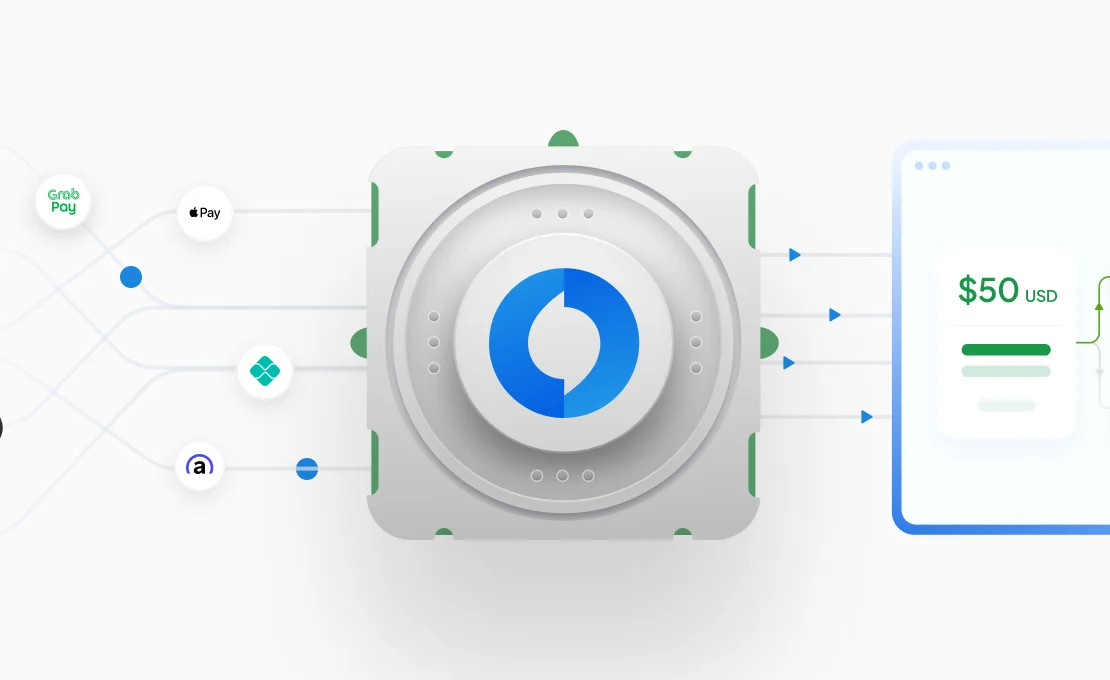
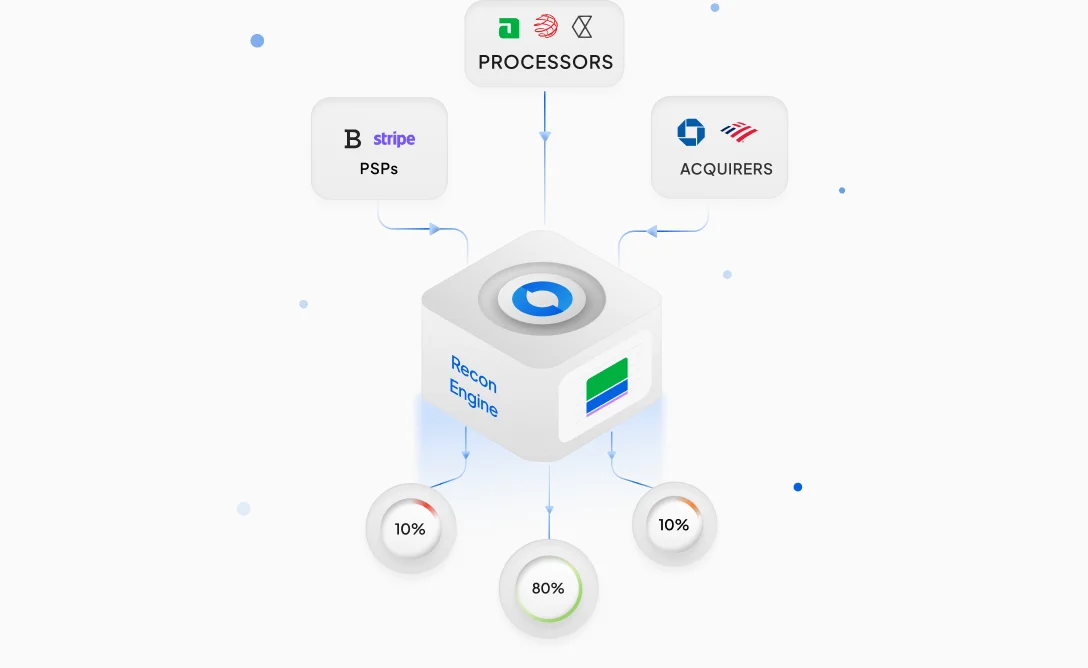
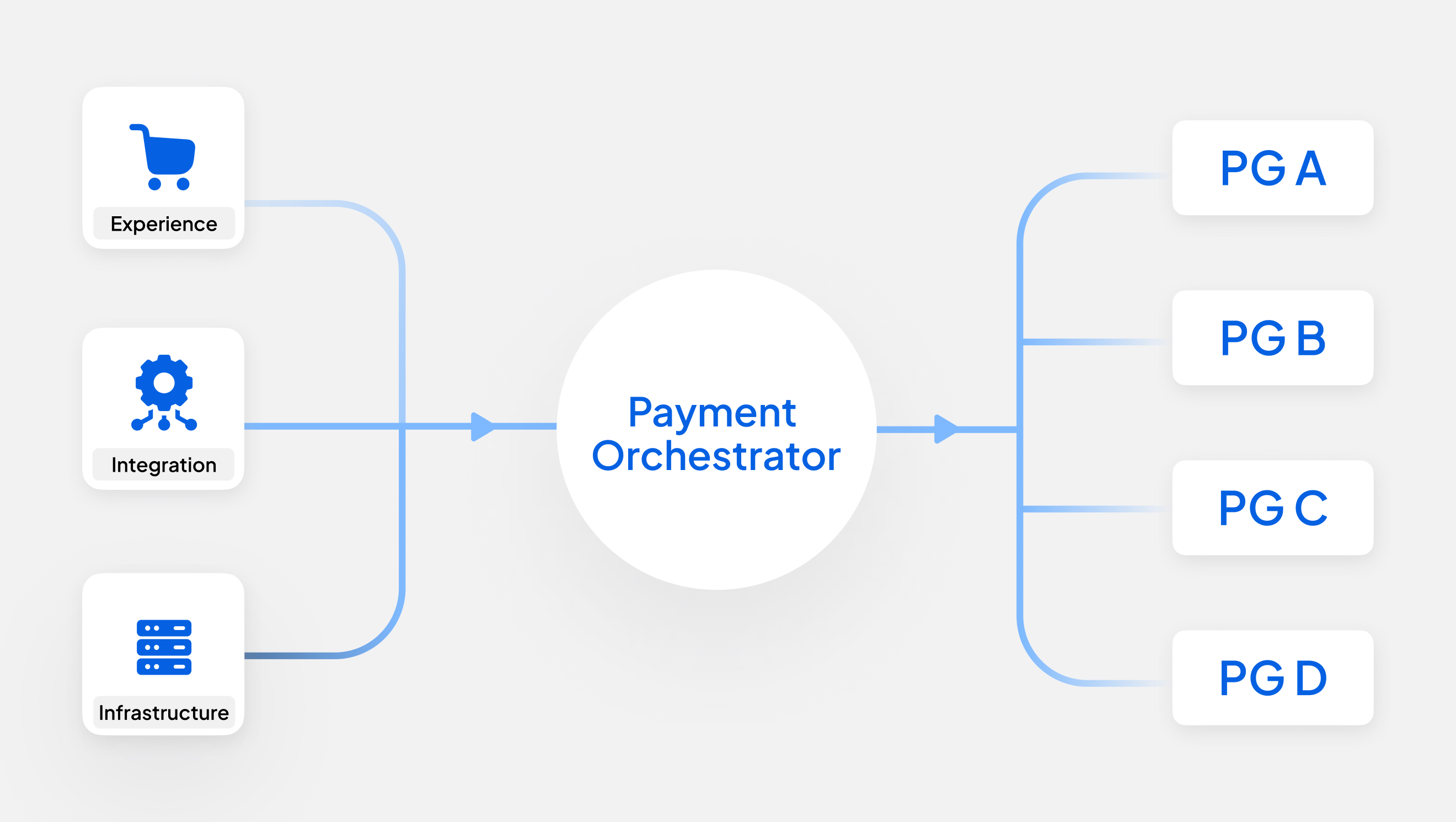
Juspay's Promos and Offers engine is built to work at the order level, so it sees the same booking these controls depend on: the itinerary, the customer, and the payment method, all as one unit rather than as separate passenger or fare records. It runs with whatever PSPs and acquirers an airline already uses, so none of this requires changing existing payment relationships. Once a Promo is applied, the engine reprices the order at checkout, which is what keeps the booking record accurate after a discount changes what was actually paid.
The Checkout that is integrated to the PSS
Most airlines want to run promotions at the payment layer, but discounting there usually breaks the booking record. The PSS still holds the original fare, so ticketing, settlement and refunds all go out of sync.
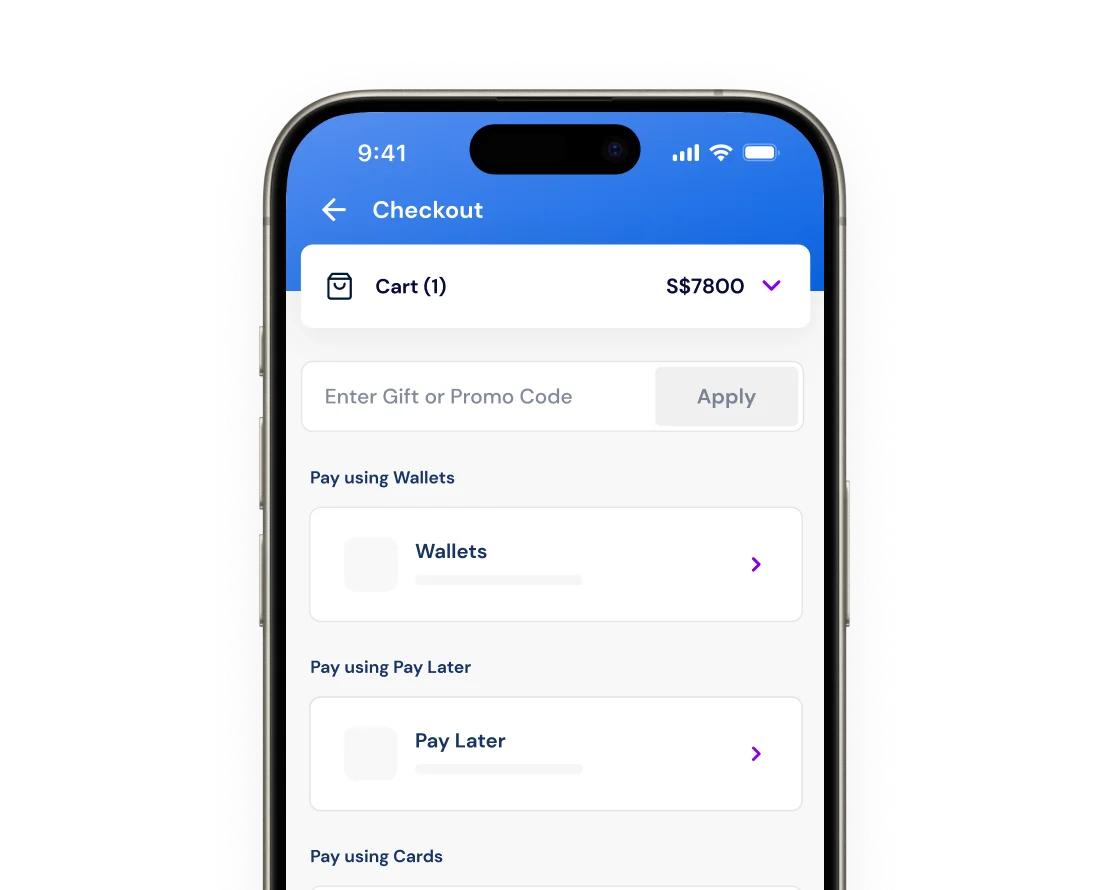
Juspay's promo engine applies the discount at checkout and then calls the repricing API of the PSS so the booking reflects the actual amount paid. The result is that Promotions can run at the payment layer without creating reconciliation gaps downstream.
Promotions can carry several conditions at once
Seeing the whole order also changes how specific a promotion can be. Instead of one blunt promo code for everyone, three dimensions are available to build on.
- The trip. Origin and destination, one-way or return, cabin class, how full the flight is, and the ancillary being sold. A discount meant to fill seats on a quiet flight is not the same as a fare promotion on a busy route, and the engine can tell them apart.
- The traveler. Loyalty status, recent travel history, whether they are a new or returning customer, and the channel they booked through.
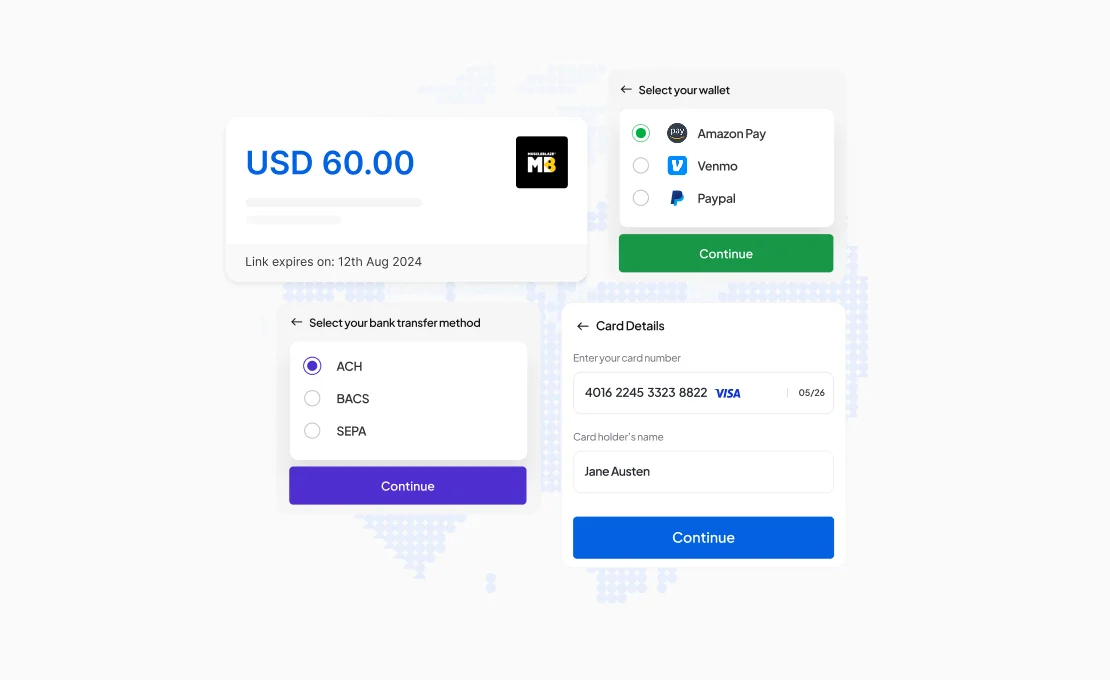
- The payment. Card network, issuing bank, card type, or a specific BIN range. A standalone promotions tool never sees this one. It is also what allows airline-funded installment plans, and part-payment in points with the rest on any method, inside a single checkout.
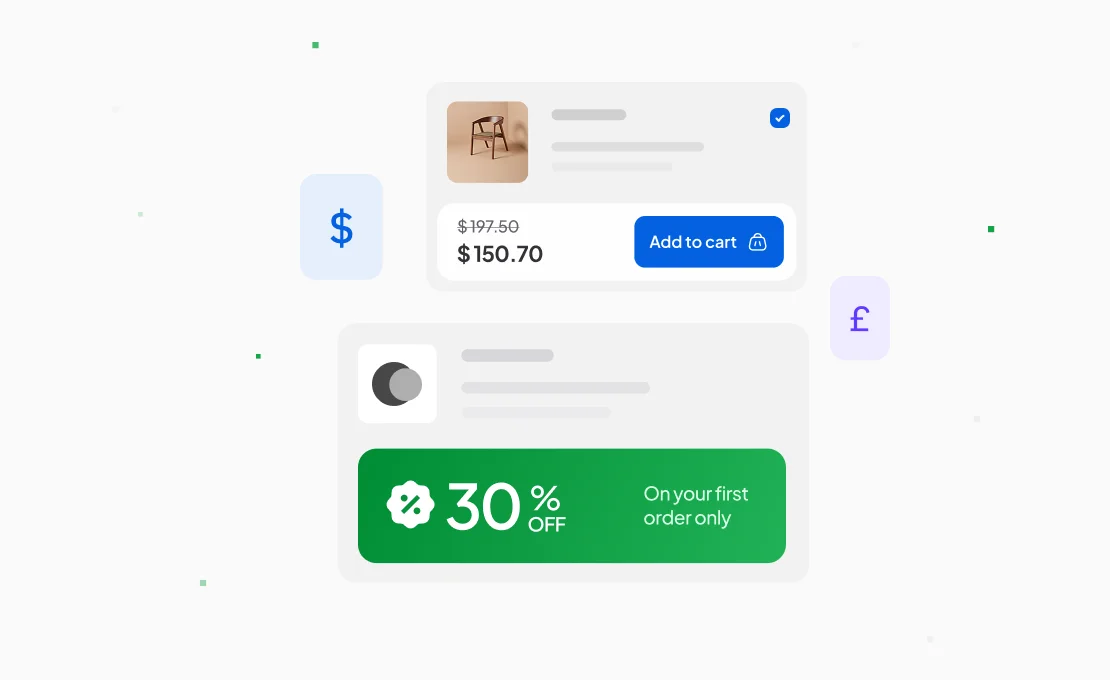
The conditions combine. A single rule can run 10% off on one route, capped per booking, usable once per customer, and only on chosen days. The result is an offer reaching customers who need a reason to book, rather than a discount handed to customers who were going to book anyway.
Every stage of the journey
The order starts at discovery, and promotions can too. An order-level engine can be called at any point in the booking journey, allowing airlines to surface relevant offers as early as the search results, when travelers are still comparing fares and deciding whether to book.
At this stage, the engine works with the information already available and adds further context, including payment details, as the customer moves through checkout.
This gives airlines an opportunity to improve look-to-book conversion. Searches significantly outnumber completed bookings, and fare display is often where customers compare options and leave. Showing the right offer at this point can influence the decision earlier, converting more searches into bookings while applying the same promotion rules through to payment.
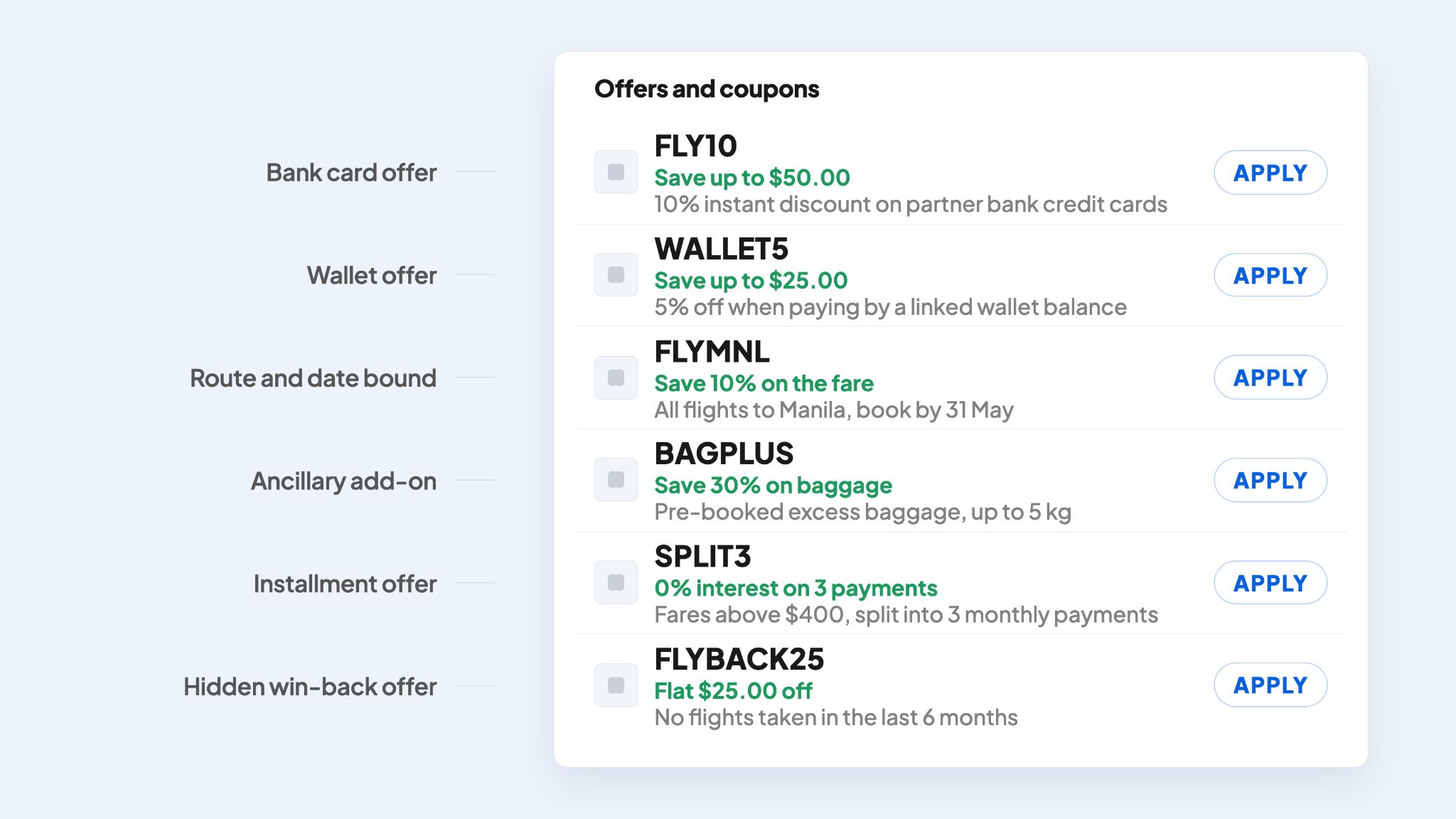
How airlines use order-level Promotions today
In practice these come down to a handful of recurring types.
- Bank and card promos. An instant discount tied to a specific issuer, network, or card type, applied at checkout. Typically co-funded with the bank.
- Installment promos. An interest-free or airline-funded three or six month plan on higher-value fares. Lowers the barrier on long-haul and multi-passenger bookings, where the size of the total is the reason people hesitate.
- Search-stage fare promos. A discount shown against the fare while the traveler is still comparing. Works on look-to-book, and is the only one of these that acts before the traveler has settled on an airline.
- Ancillary promos. A discount on seats, bags, or a bundle when it is added to the booking. Raises revenue per order instead of discounting the fare.
- Win-back promos. A targeted discount for a customer who has not flown in a defined period, triggered by booking history rather than a public code. Aimed at reactivation rather than acquisition.
- Loyalty promos. Tier-specific discounts, or part-payment in points with the rest on any method in one checkout. Gives a repeat customer a reason to book directly.
- Channel promos. An app-only or direct-only discount, used to move volume toward the channel the airline controls.
Each promotion addresses a specific reason a booking might not convert: price at the point of comparison, the overall cost of the trip, a lapsed customer relationship, or a preferred payment method. A blanket promo code cannot make those distinctions.
With the same engine managing discount caps and abuse controls, airlines can run multiple targeted promotions simultaneously while maintaining visibility and control over how much they are giving away.
Promotions don't need to wait for Offers and Orders
Promotions are easier to run well when they are treated as a way to win bookings rather than a marketing cost. The question stops being how much discount to give and becomes where to give it and to whom. At the order level an offer can be aimed at the traveler who needs it, shown while that traveler is still deciding, and capped so the cost stays inside its budget. An airline that can do all three runs more offers with more confidence, and every booking recovered that way is revenue kept rather than conceded.
The industry is heading that way already. As airlines move toward order-centric retailing under Offers and Orders, the systems that decide a promotion will have to think in orders too. That migration touches reservations, ticketing, settlement and servicing, so it runs over several years and across multiple vendors. Promotions don't have to sit still for that. A promo engine can run on an order-level framework while still working against the PNRs and fare records the current PSS produces. It lets an airline run several promo types at once, each with its own conditions and its own ceiling, on the bookings its existing systems already generate. The booking will probably take years to actually become an Order. The promotions that run on it can work that way now.
Key Takeaways
- Promotions set up in the Passenger Service System (PSS) trigger on any booking that matches the rule. A traveler who was always going to book gets the same discount as one about to abandon, and the budget is spent either way.
- A fixed discount applied per passenger, and sometimes per leg, multiplies on multi-passenger and return bookings unless an order-level cap limits it. With IATA forecasting a 2.0% industry net margin for 2026, about $4.50 of net profit per passenger, that excess is hard to absorb.
- Travelers in the Middle East, Southeast Asia, Latin America and India often expect payment-linked offers at checkout; in the US and Europe, co-branded cards, points and miles carry more weight. Separate systems for each incentive make it hard to see what a campaign really costs or which one drove the booking.
- An order-level engine sees the itinerary, the customer and the payment method as one booking. A fixed discount applies once under a per-order cap, and misuse checks run on device and payment signals as the discount is granted.
- A single rule can combine trip, traveler and payment conditions, such as one route, new customers only and a partner bank's cards, under a per-booking cap. That aims the discount at travelers who need a reason to book.
- Offers can appear from the search results onward, where travelers compare fares and often leave, so promotions work on look-to-book conversion as well as checkout. The same rules carry through to payment.
- Airlines use order-level promotions in seven recurring forms, from bank and card promos to win-back offers, each aimed at a different reason a booking stalls. One engine running all of them applies the same caps and abuse controls and shows how much the airline is giving away in total.
- Discounting at payment usually leaves the PSS holding the original fare, so ticketing, settlement and refunds go out of sync. Juspay's Promos & Offers engine applies the discount at checkout and calls the PSS repricing API so the booking matches what was paid, using the airline's existing PSPs and acquirers.
- A 2025 Accelya and Atmosphere Research Group report found only 27% of airlines had taken substantive steps toward IATA's Offers and Orders. An order-level engine can run promotions today on the PNRs and fare records the current PSS produces, without waiting for that migration.
Frequently Asked Questions
What is the difference between fare-level and order-level airline promotions?
Fare-level promotions are typically applied by the Passenger Service System (PSS) to each passenger or journey in a booking, while order-level promotions are calculated once against the whole booking. Because the PSS prices by passenger, itinerary and fare class, a fixed discount can repeat for every passenger and leg. An order-level engine sees one order holding the itinerary, customer and payment method, so it applies the discount once, under a cap, and can target it on customer and payment data.
How does an order-level cap control promotional spend?
An order-level cap sets the most a promotion can take off a booking, however many passengers or legs it contains. Without one, a $50 code applied per passenger removes $200 from a four-passenger booking, and per-leg application on a return trip can double that. With IATA forecasting a 2.0% industry net margin for 2026, about $4.50 of net profit per passenger, holding each campaign to its intended budget matters for any high-volume airline.
How can airlines avoid giving discounts to travelers who would have booked anyway?
Airlines can narrow eligibility using conditions on the traveler and the payment as well as the trip. A promotion set up in the PSS applies to every booking that matches its rule, so a traveler who was always going to book gets the same discount as one about to abandon. An order-level engine can combine route, cabin, loyalty tier, booking history, channel and card issuer in one rule, which aims the offer at travelers who need a reason to book.
Do airlines need IATA's Offers and Orders in place before running order-level promotions?
No. An order-level promotions engine can run today on the PNRs and fare records the current PSS produces. IATA's Offers and Orders programme is moving airlines from tickets, fare rules and ancillary documents toward offers and a single order, and IATA is targeting 2030 for the standards and processes to be ready. Adoption has been slow, with a 2025 Accelya and Atmosphere Research Group report finding only 27% of airlines had taken substantive steps.
How do airline promotion strategies differ by region?
They split broadly between payment-linked offers and loyalty-led ones. Travelers in the Middle East, Southeast Asia, Latin America and India often expect offers at checkout, such as issuer discounts or interest-free installments on higher-value fares, while co-branded cards, points and miles play a bigger role in the US and Europe. Card offers, installments, loyalty redemptions and fare promotions are typically managed in separate systems, which makes a campaign's true cost and the incentive that drove the booking hard to see.
What types of promotions do airlines run at the order level?
Most fall into seven recurring types: bank and card promos, typically co-funded with the issuing bank; interest-free or airline-funded installment plans on higher-value fares; fare discounts shown during search; discounts on seats, bags or bundles; win-back offers for customers who have not flown in a set period; loyalty tier discounts and part-payment with points; and app-only or direct-only channel promos. Each addresses a different reason a booking might not convert.
How do card-linked, installment and points promotions work at airline checkout?
They are decided at the order level, because they depend on the payment method the traveler chooses. An airline can target an offer by card network, issuing bank, card type or BIN range, fund a three- or six-month installment plan as the promotion, or let a customer pay part of the booking in points and the rest by any method in one checkout. A promotions tool that never sees the payment cannot run these offers.
How do search-stage promotions improve an airline's look-to-book ratio?
They reach travelers while they are still comparing fares, the point where many leave without booking. Look-to-book compares searches with completed bookings, and for airlines, searches far outnumber bookings. An order-level engine can be called at any point in the booking journey, so it can show an offer in the search results using what it already knows, then add payment details as the traveler reaches checkout. The same promotion rules apply through to payment.
How do airlines stop coupon misuse and high-frequency redemption?
Airlines catch coupon misuse and high-frequency redemption by checking device, payment instrument and behavioral signals at the moment a discount is granted. Those signals belong to the order and never reach the reservation record, so a promotion run only from the PSS cannot use them, and misuse tends to surface in a reconciliation report weeks later. An order-level engine evaluates them alongside the booking, so velocity limits and misuse rules apply before the discount goes out.
Can airlines apply promotions at the payment stage without breaking the PSS booking record?
Yes, as long as the booking is repriced in the PSS after the discount is applied. A discount taken only at the payment step leaves the PSS holding the original fare, so ticketing, settlement and refunds fall out of sync with what the traveler paid. Juspay's Promos & Offers engine applies the discount at checkout and then calls the PSS repricing API, so the booking record reflects the amount actually paid and no reconciliation gap opens downstream.
Does an order-level promotions engine replace the airline's Passenger Service System?
No. An order-level promotions engine runs alongside the PSS and works on the passenger name records (PNRs) and fare records it already produces. Juspay's engine also runs with the payment service providers (PSPs) and acquirers an airline already uses, so existing payment relationships stay in place. That lets an airline run several promotion types at once, each with its own conditions and ceiling, on the bookings its current systems generate.
What is Juspay's Promos & Offers engine?
Juspay's Promos & Offers engine is an order-level promotions engine. For airlines, it treats the itinerary, the customer and the payment method as one booking, so promotions can appear from search through payment, carry a per-order cap, combine trip, traveler and payment conditions, and run under misuse and velocity controls. It runs alongside the existing PSS, works with the airline's current PSPs and acquirers, and reprices the order in the PSS once a discount is applied.